Engineering Excellence in Biomedicine: How ASME Standards Power Accurate Computational Solid Mechanics
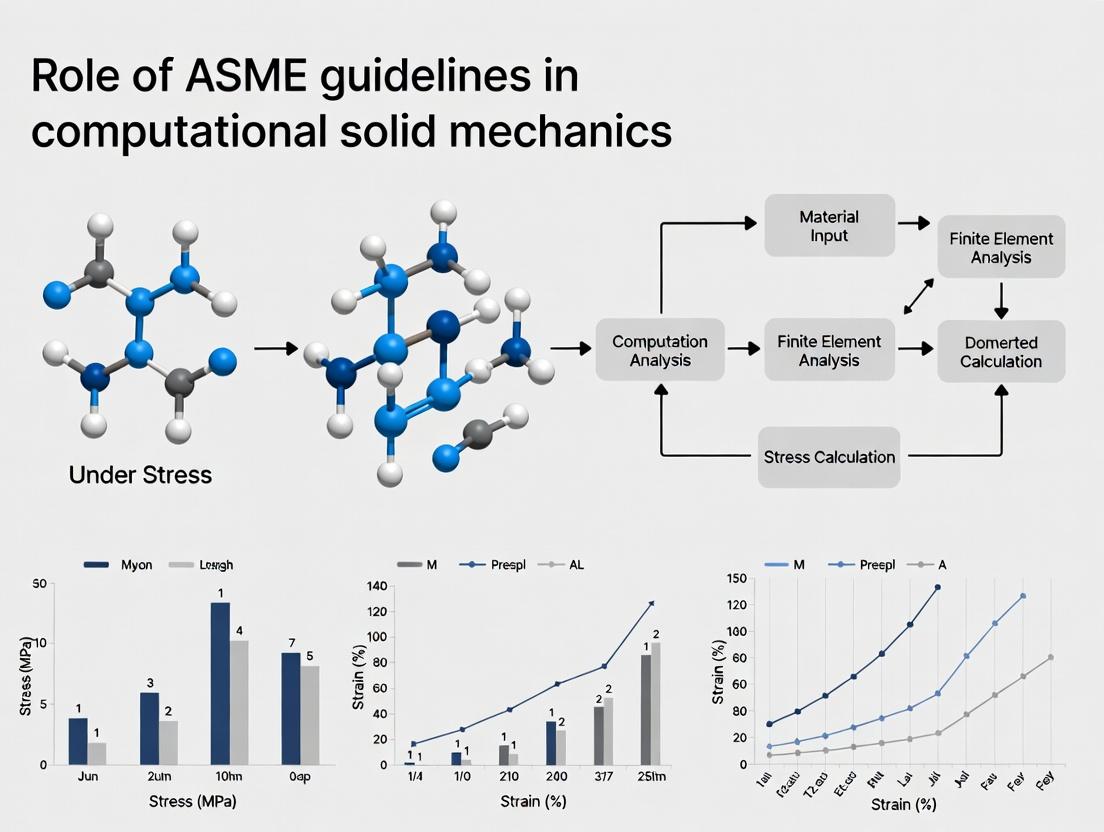
This article explores the critical, yet often overlooked, role of ASME (American Society of Mechanical Engineers) guidelines in advancing computational solid mechanics (CSM) for biomedical and pharmaceutical research.
Engineering Excellence in Biomedicine: How ASME Standards Power Accurate Computational Solid Mechanics
Abstract
This article explores the critical, yet often overlooked, role of ASME (American Society of Mechanical Engineers) guidelines in advancing computational solid mechanics (CSM) for biomedical and pharmaceutical research. It provides a foundational understanding of key ASME V&V standards, demonstrates their methodological application in modeling biological tissues and drug delivery systems, addresses common troubleshooting and optimization challenges in biomechanical simulations, and establishes a framework for validation and comparative analysis against experimental data. Targeted at researchers and development professionals, this guide synthesizes how adherence to these rigorous engineering standards enhances the credibility, reproducibility, and regulatory acceptance of computational models in drug and device development.
Why ASME? Building a Rock-Solid Foundation for Biomechanical Simulation
Thesis Context: Within the broader discourse on the role of ASME guidelines in computational solid mechanics research, the standards V&V 10 and V&V 20 provide the critical, structured framework for establishing credibility in computational models and simulations. Their systematic application is fundamental to advancing reliable research outcomes.
Core Concepts and Definitions
Verification and Validation (V&V) are formal processes used to assess the accuracy and reliability of computational simulations.
- Verification: The process of determining that a computational model accurately represents the underlying mathematical model and its solution (i.e., "solving the equations right"). It addresses code and calculation correctness.
- Validation: The process of determining the degree to which a computational model is an accurate representation of the real world from the perspective of the intended model uses (i.e., "solving the right equations"). It addresses model physics fidelity.
ASME V&V 10 - Guide for Verification and Validation in Computational Solid Mechanics
ASME V&V 10 provides an overarching framework for V&V activities specific to solid mechanics, including linear and nonlinear structural and materials response.
Core Principles & Process Flow
The standard outlines a step-by-step methodology, logically connecting program objectives, model development, and V&V activities.
Diagram: ASME V&V 10 Core Process Flow
Key Methodologies
Code Verification: Uses order-of-accuracy tests (e.g., grid convergence index - GCI) to confirm the computational model solves the mathematical equations correctly. Solution Verification: Quantifies numerical errors (e.g., discretization, iteration) in a specific calculation. The Richardson Extrapolation method is a standard technique. Validation: Involves comparing simulation results with high-quality experimental data from validation experiments. Key metrics include validation metrics like the Comparison Error (E) and Validation Uncertainty (u_val).
Table 1: Common V&V Metrics in ASME V&V 10
| Metric | Formula/Purpose | Acceptability Criterion | ||
|---|---|---|---|---|
| Grid Convergence Index (GCI) | ( GCI = F_s \cdot \frac{ | \epsilon | }{r^p - 1} ) | ( GCI \to 0 ) with mesh refinement; used to estimate discretization error. |
| Comparison Error (E) | ( E = S - D ) | Difference between simulation (S) and experimental data (D) at validation points. | ||
| Validation Uncertainty (u_val) | ( u{val} = \sqrt{u{input}^2 + u{num}^2 + u{D}^2} ) | Combined uncertainty from input parameters, numerical solution, and experimental data. | ||
| Validation Comparison | Check if ( | E | \le u_{val} ) | If true, agreement is within uncertainty; model is validated for the conditions tested. |
Experimental Protocol for a Validation Benchmark (V&V 10):
- Objective: Generate high-fidelity data for a well-defined physical problem (e.g., elastoplastic deformation of a notched tensile specimen).
- Material Characterization: Perform standard tests (tensile, compression) to define material model parameters (Young's modulus, yield stress, hardening law).
- Instrumentation: Use digital image correlation (DIC) for full-field strain measurement and calibrated load cells for force.
- Control & Documentation: Rigorously control and document boundary conditions, loading rates, and environmental conditions.
- Uncertainty Quantification: Estimate uncertainties in measurements (e.g., strain resolution from DIC, load cell accuracy).
ASME V&V 20 - Standard for Verification and Validation in Computational Fluid Dynamics and Heat Transfer
V&V 20 provides a complementary, prescriptive standard focused on CFD and heat transfer, with a stronger emphasis on quantitative uncertainty analysis.
The V&V 20 Hierarchy: From Unit to System Level
The standard defines a structured approach to validation at increasing levels of complexity.
Diagram: ASME V&V 20 Validation Hierarchy
Quantitative Validation Procedure
V&V 20 mandates a detailed analysis to compare simulation and experimental results, explicitly separating various sources of uncertainty.
Table 2: Primary Uncertainty Sources in ASME V&V 20
| Source | Symbol | Description | Typical Evaluation Method |
|---|---|---|---|
| Input Parameter | ( u_{input} ) | Uncertainty in simulation input values (e.g., viscosity, boundary conditions). | Sensitivity analysis, expert judgment, supplier data. |
| Numerical Solution | ( u_{num} ) | Uncertainty from discretization, iteration, and round-off errors. | Grid and time-step refinement studies (GCI). |
| Experimental Data | ( u_{D} ) | Uncertainty in the benchmark measurement data. | Analysis of calibration, repeatability, and spatial/temporal resolution. |
Experimental Protocol for CFD Validation (V&V 20):
- Benchmark Selection: Choose a canonical flow (e.g., lid-driven cavity, turbulent jet) with high-quality reference data.
- Measurement Techniques: Employ particle image velocimetry (PIV) for velocity fields, laser-induced fluorescence (LIF) for scalar concentrations, and thermocouples/RTDs for temperature.
- Uncertainty Budgeting: Develop a comprehensive uncertainty budget for each measured quantity (Type A and Type B evaluations per ISO guidelines).
- Data Archiving: Archive raw data, calibration certificates, and detailed experimental conditions in a standardized format (e.g., as recommended by the Journal of Fluids Engineering).
- Comparison Points: Define specific spatial locations and/or integrated quantities (e.g., drag coefficient, Nusselt number) for direct simulation-to-experiment comparison.
The Scientist's Toolkit: Essential Research Reagent Solutions
Table 3: Key Computational & Experimental Resources for V&V
| Item/Category | Function in V&V Process | Example/Specification |
|---|---|---|
| Benchmark Experiment Database | Provides high-quality validation data with documented uncertainties. | NASA Turbulence Modeling Resource (TMR), ERCOFTAC Classic Collection, NIST Digital Library of Mathematical Functions. |
| Grid Generation & Refinement Tool | Creates computational meshes for solution verification studies. | Pointwise, ANSYS Meshing, snappyHexMesh (OpenFOAM). Capable of producing families of systematically refined grids. |
| Uncertainty Quantification (UQ) Software | Propagates input uncertainties and calculates validation metrics. | DAKOTA (Sandia), Uncertainty Quantification Toolkit (UQTk), OpenCOSSAN. |
| Reference Solution Code | Provides highly accurate solutions for code verification. | Method of Manufactured Solutions (MMS) code, NIST Structured Grid Code benchmarks. |
| Calibrated Measurement Hardware | Generates reliable experimental data for validation. | PIV System (e.g., LaVision), DIC System (e.g., Correlated Solutions), ISO/IEC 17025 accredited calibration for sensors. |
| Standardized Material Test Specimens | Ensures consistent material property input for simulations. | ASTM E8/E8M tensile specimens, ASTM E399 compact tension specimens for fracture toughness. |
In computational solid mechanics research, the credibility of numerical simulations is paramount. The ASME (American Society of Mechanical Engineers) V&V 20-2009 guide, "Standard for Verification and Validation in Computational Fluid Dynamics and Heat Transfer," provides the foundational framework, which is extensively adapted for solid mechanics. This whitepaper details the core principles of Code Verification, Solution Verification, and Validation (V&V), framing them within the critical role of ASME guidelines for ensuring predictive capability in biomechanical applications, including medical device and drug delivery system development.
Foundational Definitions and ASME Framework
The ASME guide formally defines the V&V triad:
- Code Verification: The process of ensuring that the computational model is solved correctly. It asks, "Is the code solving the equations correctly?"
- Solution Verification: The process of quantifying the numerical accuracy of a given computational solution. It asks, "How accurate is this specific solution?"
- Validation: The process of determining the degree to which a model is an accurate representation of the real world. It asks, "Is the code solving the correct equations?"
These steps form a structured approach to establish the predictive credibility of simulations used in critical applications, such as stress analysis in bone implants or polymer degradation in controlled-release drug depots.
Code Verification: Ensuring Correct Implementation
Code Verification confirms the mathematical model (governing PDEs) is correctly implemented in the software with no programming errors.
Methodology: The primary method is the Method of Manufactured Solutions (MMS).
- Manufacture a Solution: Choose an arbitrary, non-trivial analytical function for the dependent variables (e.g., displacement, stress).
- Derive Source Terms: Substitute the manufactured solution into the governing PDEs. The residual is the required source term.
- Run Simulation: Solve the PDEs with the added source term using the computational code.
- Compare Results: Compute the error between the code's numerical solution and the manufactured analytical solution.
- Check Convergence: Demonstrate that the numerical error reduces at the expected theoretical order of accuracy as the mesh/grid is refined.
Key Research Reagent Solutions for Code Verification:
| Item | Function in Verification |
|---|---|
| Method of Manufactured Solutions (MMS) | The primary "reagent" for testing code correctness by providing an exact benchmark. |
| Order-of-Accuracy Test Suite | A set of refined meshes/grids to formally demonstrate convergence rates. |
| Analytical Benchmark Library | Curated collection of simple problems with known solutions (e.g., Timoshenko beam, Lame problem). |
| Unit/Regression Test Framework | Automated software tests to ensure code changes do not break verified functionality. |
Title: Code Verification Workflow via MMS
Solution Verification: Quantifying Numerical Error
Solution Verification estimates the numerical error in a specific simulation due to discretization (spatial, temporal). Its key output is the numerical uncertainty, Unum.
Methodology: Grid Convergence Study (GCI Method) The ASME-endorsed Grid Convergence Index (GCI) provides a uniform method for reporting discretization error.
- Generate Grids: Create three or more systematically refined meshes (e.g., fine, medium, coarse).
- Run Simulations: Solve the actual problem of interest on each mesh.
- Calculate Key Metrics: Extract a key solution variable (e.g., max stress, strain energy).
- Compute Apparent Order: Determine the observed order of convergence (p).
- Calculate GCI: Apply the GCI formula to estimate the error band on the finest grid solution.
Quantitative Data from a Representative Solid Mechanics Study (Plate with Hole):
Table 1: Grid Convergence Study for Maximum Von Mises Stress
| Mesh | Elements | Max Stress (MPa) | Relative Error (%) | GCI (%) |
|---|---|---|---|---|
| Coarse | 512 | 302.5 | 4.12 | 5.21 |
| Medium | 2,048 | 314.8 | 0.25 | 0.31 |
| Fine | 8,192 | 315.6 | (Reference) | 0.08 |
Table 2: Extracted Convergence Parameters
| Parameter | Symbol | Value |
|---|---|---|
| Observed Order | p | 1.92 |
| Asymptotic Ratio | R | 3.96 |
| Fine-Grid GCI | GCIfine | 0.08% |
Validation: Assessing Model Fidelity to Reality
Validation assesses the physical accuracy of the mathematical model by comparing simulation results with high-fidelity experimental data.
Experimental Protocol for Validation (Example: Soft Tissue Indentation):
- Objective: Validate a hyperelastic (Ogden) material model for liver tissue.
- Apparatus: Instron materials tester, spherical indenter, fresh porcine liver sample, PBS bath.
- Procedure:
- Mount tissue sample in bath to prevent dehydration.
- Perform pre-conditioning cycles.
- Execute indentation test at constant displacement rate, recording force (F) and displacement (d).
- Measure indenter geometry and sample dimensions via calipers.
- Repeat for multiple samples (N ≥ 5).
- Simulation: Recreate the experiment in FEA using the proposed Ogden model.
- Comparison: Compare the simulated and experimental force-displacement curves.
- Validation Metric: Calculate the validation uncertainty, Uval, and compare the error (E) against it. If |E| ≤ Uval, the model is validated at the Uval level.
Title: Model Validation Process Flow
The Integrated V&V Process in Practice
For a predictive simulation in drug development (e.g., modeling a subcutaneous drug pellet), the principles are applied sequentially. Code Verification builds trust in the FEA software. Solution Verification quantifies the numerical error in the pellet's stress field. Validation, against bench-top dissolution or mechanical tests, establishes the model's predictive capability for drug release kinetics under different physiological loads.
Key Research Reagent Solutions for Integrated V&V:
| Item | Function in V&V Process |
|---|---|
| High-Fidelity Experimental Rig | Provides validation benchmark data (e.g., DIC for strain, bioreactors for degradation). |
| Uncertainty Quantification (UQ) Toolbox | Software/methods to quantify input (material) and experimental uncertainty. |
| Reference Benchmark Database | Community-accepted validation cases (e.g., silicone heart valve, composite bone plate). |
| Calibrated Material Testers | (e.g., DMA, rheometer) to provide accurate constitutive model parameters. |
Adherence to the ASME-guided principles of Code Verification, Solution Verification, and Validation forms the bedrock of credible computational solid mechanics research. For scientists and drug development professionals, this rigorous framework transforms simulations from intriguing visualizations into quantified predictive tools, essential for reducing physical prototyping, understanding complex biomechanical interactions, and accelerating the development of safe and effective medical therapies.
This whitepaper explores the systematic application of mechanical engineering principles, specifically those codified in ASME standards for computational solid mechanics, to the study of biological systems. Within the broader thesis on the role of ASME guidelines, we posit that their core tenets—verification & validation (V&V), uncertainty quantification (UQ), and standardized reporting—provide an indispensable framework for robust, reproducible computational biology, particularly in areas like cellular biomechanics and drug development targeting mechanobiology.
Core Engineering Principles in a Biological Context
ASME V&V 20-2009 and similar guidelines establish a structured approach for building confidence in computational models.
- Verification (Solving Equations Right): Applied to biological finite element analysis (FEA) of, for example, a cell membrane, this ensures the computational mesh and numerical solvers are error-free.
- Validation (Solving the Right Equations): This assesses whether the model's predictions match real-world experimental data from biological systems.
Table 1: Translating ASME V&V Concepts to Biological Modeling
| ASME Concept | Engineering Example | Biological Systems Translation | Quantitative Metric |
|---|---|---|---|
| Code Verification | Benchmarking FEA software against analytical beam deflection solutions. | Benchmarking a cytoskeleton simulation against known microtubule buckling force. | Error vs. known solution < 2%. |
| Solution Verification | Mesh convergence study for stress in a pressure vessel. | Mesh convergence study for strain energy in a 3D nucleus model. | Grid Convergence Index (GCI) < 5%. |
| Validation | Comparing simulated turbine blade vibration to physical sensor data. | Comparing predicted cell deformation in microfluidic channel to live-cell microscopy data. | Normalized root-mean-square error (NRMSE) < 15% between simulation and experiment. |
| Uncertainty Quantification | Propagating material property tolerances in a bracket stress analysis. | Propagating variance in ligand concentration, receptor density, and binding affinity in a signaling model. | 95% confidence interval for model output (e.g., predicted ERK activation). |
Experimental Protocols for Validation
To validate a computational model of cellular mechanotransduction, the following correlative experiment is essential.
Protocol: Quantifying Strain-Induced Nuclear Translocation of YAP/TAZ
- Objective: Generate quantitative data on transcription factor localization vs. applied substrate strain to validate a coupled FEA - signaling pathway model.
- Materials: Polyacrylamide hydrogels with tunable stiffness (1-50 kPa), functionalized with fibronectin. Fluorescently tagged YAP/TAZ cell line (e.g., MCF-10A). Cyclic strain device compatible with live imaging.
- Method:
- Seed cells on hydrogels and allow to adhere for 24h.
- Subject gels to a defined, uniform cyclic tensile strain (e.g., 10% strain, 0.5 Hz) using the strain device mounted on a confocal microscope stage.
- Acquire z-stack images at 0, 15, 30, 60, and 120-minute time points under controlled conditions (37°C, 5% CO₂).
- Fix cells at 120 min and immunostain for YAP/TAZ and DAPI (nucleus).
- Image Analysis: Calculate the nuclear-to-cytoplasmic (N/C) fluorescence intensity ratio for YAP/TAZ for ≥100 cells per condition using software (e.g., ImageJ/FIJI).
- Statistical Analysis: Compare N/C ratios between static and strained conditions using a Mann-Whitney U test. Report mean ± standard deviation.
The Scientist's Toolkit: Research Reagent Solutions
Table 2: Essential Reagents for Mechanobiology Experiments
| Reagent/Material | Function in Experiment | Example Product/Catalog |
|---|---|---|
| Tunable Polyacrylamide Hydrogels | Provides a biocompatible substrate with precisely controllable elastic modulus to mimic tissue stiffness. | BioTek's Softwell Hydrogel Plates, Cytosoft plates. |
| Fibronectin, Functionalized | Coats hydrogel surface to promote integrin-mediated cell adhesion, enabling mechanosensing. | Corning Fibronectin, Human, Functional Grade. |
| YAP/TAZ Fluorescent Reporter Cell Line | Enables live-cell, quantitative tracking of key mechanotransduction effector localization. | Santa Cruz Biotechnology (sc-101199), or custom lentiviral constructs. |
| Cyclic Strain Device (Live-Cell) | Applies precise, physiologically relevant mechanical loads to cell cultures during imaging. | Flexcell International, STREX Inc. BioStrech systems. |
| SiRNA for Mechanosensors (e.g., Piezo1) | Validates the specific role of a mechanosensitive ion channel in the observed response. | Dharmacon ON-TARGETplus Piezo1 siRNA. |
| FRET-based Tension Biosensors | Directly visualizes molecular-scale forces across specific proteins (e.g., integrin, vinculin). | Genetically encoded sensors (e.g., VinTS, integrin β1 TS). |
Visualizing Systems and Workflows
Diagram 1: Core Mechanotransduction Pathway from ECM to Nucleus
Diagram 2: Integrated Computational-Experimental V&V Workflow
The rigorous, process-oriented framework of ASME computational solid mechanics guidelines offers a powerful template for elevating research in biological systems. By mandating strict V&V, UQ, and clear documentation, this translation of engineering rigor directly addresses the reproducibility crisis and enables the development of predictive, high-fidelity models. For drug development targeting mechanobiology, such models are critical for in silico screening and optimizing therapeutic strategies that modulate cellular responses to mechanical forces.
1. Introduction: Integrating ASME V&V 40 into Biomedical Contexts The American Society of Mechanical Engineers (ASME) Verification and Validation (V&V) 40 standard provides a risk-informed framework for assessing computational models. In computational solid mechanics research for biomedical applications—such as stent deployment, bone implant stress analysis, or soft tissue injury prediction—adherence to these guidelines is not optional. It is a critical safeguard against consequential errors that can derail research, waste resources, and, ultimately, jeopardize patient safety in downstream drug or device development. This guide details the risks of neglecting standards and provides protocols for compliant practice.
2. Quantitative Impact: Errors and Costs from Non-Standard Practices
Table 1: Documented Consequences of Inadequate Simulation V&V in Biomedical Research
| Error Type | Reported Impact (Quantitative) | Domain Example | Primary Risk Source |
|---|---|---|---|
| Material Model Error | Predicted stent recoil error of 15-22% vs. physical test. | Cardiovascular Implant | Use of isotropic (standard metal) model for anisotropic (arterial tissue) behavior. |
| Boundary Condition Mis-specification | Overestimation of bone-implant interface micromotion by up to 200%. | Orthopedics | Assuming perfect fixation vs. realistic ligamentous constraint. |
| Mesh Insensitivity Neglect | Critical stress values varied by >30% with mesh refinement. | Craniofacial Biomechanics | Failure to perform a systematic mesh convergence study. |
| Software Verification Gap | Internal algorithm errors yielding non-physical energy gains. | General FEA | Blind trust in commercial solver black box without benchmark verification. |
3. Core Methodological Protocols Aligned with ASME V&V 40
Protocol 3.1: Systematic Mesh Convergence Study
- Objective: Quantify discretization error and establish mesh-independent results.
- Materials: Finite Element Analysis (FEA) software (e.g., Abaqus, FEBio), high-performance computing (HPC) resources.
- Procedure:
- Develop a baseline mesh with a defined global element size.
- Refine the mesh globally by a factor (e.g., 1.5x, 2x) for at least three consecutive levels. Local refinement in regions of high stress gradients is mandatory.
- For each mesh, compute the Quantity of Interest (QoI) (e.g., maximum principal stress, displacement at a key point).
- Apply the Grid Convergence Index (GCI) method to estimate the discretization error and asymptotic convergence.
- Select the appropriate mesh where further refinement changes the QoI by less than a predefined threshold (e.g., <2%).
Protocol 3.2: Validation Experiment for Soft Tissue Constitutive Model
- Objective: Validate a hyperelastic (e.g., Ogden) material model for liver tissue against physical experiments.
- Materials: Fresh porcine liver tissue, biaxial tensile testing system, digital image correlation (DIC) setup, high-speed camera, simulation software.
- Procedure:
- Conduct biaxial tensile tests on liver specimens, recording force and full-field strain via DIC.
- Calibrate the hyperelastic material model parameters in the simulation software to match the experimental force-displacement data from a subset of tests (calibration set).
- Develop a high-fidelity FE model of the biaxial test, incorporating the calibrated material model and measured boundary conditions.
- Simulate the tests for a separate validation set of specimens not used in calibration.
- Compare simulation-predicted strain fields (full-field) and force values with experimental DIC data using quantitative metrics (e.g., correlation coefficient, mean absolute error). Establish credibility thresholds.
4. Visualizing Key Workflows and Relationships
Title: ASME V&V 40 Risk-Informed Workflow
Title: Model Validation Protocol Logic
5. The Scientist's Toolkit: Essential Research Reagent Solutions
Table 2: Key Resources for Standards-Compliant Biomechanical Simulation
| Item / Solution | Function & Relevance to Standards |
|---|---|
| Abaqus FEA with Isight | Industry-standard FEA suite; Isight enables automated parametric studies, optimization, and UQ workflows required for systematic V&V. |
| FEBio (open-source) | Specialized FEA for biomechanics; explicitly developed with a focus on verification and validation against biomechanics test data. |
| DIC System (e.g., GOM Aramis) | Provides full-field, high-resolution experimental strain data essential for quantitative validation of soft tissue or complex deformation simulations. |
| NIST Standard Reference Models | Benchmarks (e.g., for arterial wall mechanics) provide verified solutions for software and methodology verification. |
| ASME V&V 40-2018 Standard Document | The definitive guideline for establishing a risk-informed credibility framework; defines key terms and process. |
| UQ Tools (e.g., Dakota, SU2) | Open-source libraries for performing sensitivity analysis, uncertainty propagation, and calibration, integral to V&V. |
Computational Solid Mechanics (CSM) is pivotal in high-stakes fields, including medical device and drug delivery system development. The ASME V&V 20-2009 Standard for Verification and Validation in Computational Fluid Dynamics and Heat Transfer and its overarching framework, ASME V&V 10-2019 Guide for Verification and Validation in Computational Solid Mechanics, provide the authoritative foundation for assessing computational model credibility. This guide defines the core terminology—Uncertainty, Error, and Credibility—within this structured framework, establishing the language necessary for rigorous, reproducible research.
Foundational Definitions
- Uncertainty: A potential deficiency in any phase or activity of the modeling process that is due to lack of knowledge. It is epistemic and reducible. In CSM, it is quantified but not known exactly.
- Error: A recognizable deficiency in any phase or activity of modeling that is not due to lack of knowledge. It is often aleatory (irreducible inherent variability) or a mistake. The difference between a computed result and the true value.
- Credibility: The trust, established through evidence, in the predictive capability of a computational model for a specific context of use. It is the ultimate goal of the ASME V&V process.
Hierarchical Relationship and Quantification
The ASME framework establishes a hierarchical relationship for assessing numerical error, which feeds into overall uncertainty and credibility assessment.
Diagram 1: ASME-Based V&V Pathway to Credibility
Table 1: Taxonomy and Quantification of Key CSM Uncertainties & Errors
| Category | Type | Source Example in CSM | Typical Quantification Method | Reducible? |
|---|---|---|---|---|
| Parametric Uncertainty | Uncertainty | Material properties (Young's modulus, yield stress), load magnitudes, boundary conditions. | Probabilistic distributions (Normal, Uniform), sensitivity analysis. | Yes, via better measurement. |
| Numerical Error | Error | Discretization (mesh density), iterative convergence, round-off. | Grid convergence index (GCI), residual plots, benchmarking. | Yes, via mesh refinement, tighter tolerances. |
| Modeling Error | Error | Use of linear elasticity for large-strain plasticity, simplifying complex geometry. | Comparison to high-fidelity data or benchmark experiments (Validation). | Yes, via model form improvement. |
| Code Error | Error | Bugs in solver algorithms, post-processing. | Code Verification (e.g., Method of Manufactured Solutions). | Yes, via debugging. |
| Experimental Uncertainty | Uncertainty | Scatter in validation test data, sensor noise, fixture alignment. | Statistical analysis of replicates (mean, standard deviation). | Partially, via improved instrumentation. |
Experimental Protocol for Validation (Core ASME Activity)
Validation is the cornerstone of establishing credibility. The following protocol is derived from ASME V&V 10-2019.
Objective: Quantify the modeling error by comparing simulation results to experimental data for a specified Quantity of Interest (QoI).
Methodology:
- Define Context of Use & QoI: Precisely state the model's purpose (e.g., "Predict maximum principal stress in a drug-eluting stent strut during balloon expansion"). Select QoI(s) (e.g., strain at a specific location).
- Design Validation Experiment: Create a well-characterized, physical experiment that isolates the phenomena relevant to the QoI. Document all parameters (geometry, materials, loads, boundary conditions).
- Characterize Experimental Uncertainty:
- Perform a minimum of N=5 replicate tests.
- Measure all input parameters (e.g., material properties from coupon tests) with associated uncertainty.
- Report the mean (
μ_exp) and standard deviation (σ_exp) of the QoI from the experimental data.
- Execute Computational Simulation:
- Use the mean values of experimentally measured input parameters.
- Ensure numerical errors (Table 1) are minimized and quantified via verification (e.g., GCI < 3%).
- Compute Validation Metric (
E): Calculate the comparison error. A common metric is the normalized difference:E = |(μ_sim - μ_exp)| / |μ_exp|Whereμ_simis the simulated QoI value. - Assess Accuracy: Compare
Eto the required accuracy for the Context of Use. Credibility is established ifEis within the acceptable range, considering the combined experimental and simulation uncertainties.
The Scientist's Toolkit: CSM V&V Research Reagents
Table 2: Essential Reagents & Solutions for CSM V&V Research
| Item/Reagent | Function in CSM V&V Process |
|---|---|
| Benchmark Experiment Dataset | A highly controlled, peer-accepted physical experiment (e.g., NAFEMS benchmarks) used as "ground truth" for validation. |
| Method of Manufactured Solutions (MMS) | A code verification reagent where an analytical solution is manufactured; the code's ability to recover it is tested. |
| Grid Convergence Index (GCI) Procedure | A standardized protocol (from ASME V&V 20) for quantifying discretization error and reporting mesh uncertainty. |
| Sensitivity Analysis Toolkit | Software/methods (e.g., Monte Carlo, Latin Hypercube Sampling) to rank input parameter uncertainties by their effect on QoI. |
| Uncertainty Quantification (UQ) Framework | Computational architecture (e.g., non-intrusive polynomial chaos) to propagate input uncertainties to output QoI distributions. |
| High-Fidelity Reference Model | A more complex, trusted model (e.g., high-resolution FE model, MD simulation) used to assess modeling error of a simpler model. |
The Credibility Assessment Logic Flow
The final assessment integrates all components under the ASME framework.
Diagram 2: Credibility Assessment Logic Flow
From Guideline to Workflow: Implementing ASME Standards in Biomedical CSM
Within the broader thesis on the role of ASME guidelines in computational solid mechanics research, the application of the ASME V&V 40 and V&V 10-20 standards is paramount. These standards provide a structured, risk-informed framework for assessing the credibility of computational models used in the evaluation of medical devices like bone implants and vascular stents. This guide details the step-by-step process for establishing model credibility under these guidelines, which is critical for regulatory submission and scientific confidence.
Define Context of Use and Risk Analysis
The cornerstone of the ASME V&V 40 process is the explicit definition of the Context of Use (COU). For a cardiovascular stent model, the COU could be: "To predict the magnitude of cyclic strain in the stent struts under diastolic-to-systolic pressure loading to inform fatigue safety factor calculations." For a cementless hip stem implant, it might be: "To predict the micromotion at the bone-implant interface under gait loading to assess the risk of failure for osseointegration."
The Risk Analysis categorizes the Model Influence (High, Medium, Low) based on the role the model plays in decision-making and the Decision Consequence (High, Medium, Low) based on the impact of an incorrect model prediction. This determines the required Credibility, often expressed as the Credibility Achievement Scale.
Table 1: Risk-Based Credibility Requirements Example for a Stent Fatigue Model
| Risk Category | Model Influence | Decision Consequence | Required Verification Credibility | Required Validation Credibility Tier |
|---|---|---|---|---|
| High | High (Primary evidence) | High (Patient safety) | Extensive (Full code verification) | Tier 3 (Systematic validation over full domain) |
| Medium | Medium (Supporting evidence) | Medium (Design selection) | Substantial | Tier 2 (Validation across a range of conditions) |
| Low | Low (Exploratory) | Low (Early feasibility) | Minimal | Tier 1 (Benchmarking to analytical/simple cases) |
Development of a Verification and Validation Plan
A formal V&V Plan is created, mapping the COU to specific Quantities of Interest (QOIs) (e.g., maximum principal strain in stent, interfacial micromotion) and outlining the specific activities to achieve the target credibility level.
Code and Calculation Verification (ASME V&V 10-20)
Verification answers "Are we solving the equations correctly?" It involves:
- Code Verification: Ensuring no programming errors. This is typically done via Order-of-Accuracy tests using the Method of Manufactured Solutions (MMS).
- Calculation Verification (Solution Verification): Estimating numerical errors (e.g., discretization, iteration) in the specific computational solution. This is done via a mesh convergence study.
Table 2: Example Results from a Mesh Convergence Study for a Stem Implant Model
| Mesh Size (mm) | Number of Elements | QOI: Peak Micromotion (µm) | Relative Error vs. Finest Mesh | Extrapolated Value (Richardson) |
|---|---|---|---|---|
| 2.0 | 45,000 | 42.5 | 12.1% | 48.1 µm |
| 1.0 | 225,000 | 46.8 | 3.2% | 48.3 µm |
| 0.5 | 1,250,000 | 48.2 | 0.6% | 48.5 µm |
| 0.25 (Reference) | 8,500,000 | 48.5 | 0.0% | 48.5 µm |
Experimental Protocol for Code Verification (Method of Manufactured Solutions):
- Choose a QOI (e.g., stress component).
- Manufacture a smooth, arbitrary analytical solution for the PDEs (e.g., a polynomial displacement field).
- Compute the corresponding source terms (body forces) needed to satisfy the PDEs.
- Apply the manufactured solution as a boundary condition in the simulation.
- Run simulations on a series of progressively refined meshes.
- Calculate the error between the numerical and manufactured solutions. The error should decrease at the theoretical rate of the numerical scheme (e.g., order 2 for linear elements).
Validation (ASME V&V 40)
Validation answers "Are we solving the correct equations?" It assesses model accuracy by comparing predictions to experimental data for the QOIs.
Validation Tiers:
- Tier 1: Comparison to benchmark problems or simple geometries.
- Tier 2: Comparison to subsystem or component-level tests (e.g., a single stent strut in bending, a small bone-implant coupon test).
- Tier 3: Comparison to system-level tests (e.g., a full stent in a mock artery under pulsatile pressure, a full femur with implant under physiologic loading).
Experimental Protocol for Tier 3 Stent Validation (Artery Mock Loop):
- Fabrication: Manufacture stents and compliant polymeric arterial mimics (silicone or polyurethane tubes) with known mechanical properties.
- Instrumentation: Mount the stent-artery construct in a pulsatile flow loop. Implant strain gauges or use Digital Image Correlation (DIC) on the stent surface. Use pressure sensors upstream and downstream.
- Loading: Apply physiologic pressure waveforms (e.g., 80/120 mmHg) at body temperature (37°C) for multiple cycles.
- Data Acquisition: Measure stent strut strain synchronously with pressure. Record high-speed video for DIC analysis.
- Simulation Replication: Build a corresponding Finite Element model of the stent and artery mimic. Apply identical pressure loading and material properties (from separate uniaxial tests).
- Comparison: Compare the experimental and computational QOIs (e.g., strain at 5 specific strut locations over the cardiac cycle) using validation metrics (e.g., u-pooling method for combining uncertainties).
Table 3: Example Validation Comparison for Stent Strain at Systolic Pressure (120 mmHg)
| Measurement Location | Experimental Strain (µε) [Mean ± SD] | Computational Prediction (µε) | Absolute Error (µε) | Within Experimental Uncertainty? |
|---|---|---|---|---|
| Strut Crown 1 | 2450 ± 120 | 2320 | 130 | Yes |
| Strut Crown 2 | 1980 ± 95 | 2150 | 170 | No |
| Link Midpoint | 850 ± 65 | 810 | 40 | Yes |
| Strut Side 1 | 1750 ± 110 | 1680 | 70 | Yes |
Uncertainty Quantification (UQ)
A critical component is the quantification of input uncertainties (e.g., material properties, loading, boundary conditions) and their propagation to output uncertainty in the QOIs. This is often done via Monte Carlo Simulation or Surrogate Modeling techniques.
Credibility Assessment and Reporting
All evidence from verification, validation, and UQ is compiled. The achieved credibility for each QOI is assessed against the target from the risk analysis. A comprehensive V&V Report is produced, documenting every step, assumption, and result, providing traceable evidence for the model's predictive capability within its defined COU.
Title: ASME V&V 40 Process Workflow for Implant Models
Title: Decision Logic for ASME Validation Tier Selection
The Scientist's Toolkit: Research Reagent Solutions
Table 4: Essential Materials & Tools for Implant/Stent V&V
| Item | Category | Function in V&V Process |
|---|---|---|
| Polyurethane/Silicone Artery Mimics | Biomaterial | Provides a tunable, transparent, and reproducible medium for in vitro stent validation testing, simulating vessel compliance. |
| Synbone or Sawbones Foams | Biomaterial Analog | Standardized polyurethane foams with consistent mechanical properties (cancellous/cortical) for reproducible bone implant bench testing. |
| Digital Image Correlation (DIC) System | Metrology | Non-contact optical method to measure full-field 3D displacements and strains on implant or tissue surfaces during experiments for high-resolution validation data. |
| Biaxial or Uniaxial Test System | Metrology | Characterizes the mechanical properties (elastic modulus, yield stress) of implant materials and simulated tissues (e.g., artery mimics, bone analogs) for accurate simulation inputs. |
| Pulsatile Flow Loop System | Bioreactor | Replicates physiologic pressure and flow conditions for in vitro validation of cardiovascular devices like stents or heart valves. |
| Strain Gauges & Telemetry | Sensor | Directly measures strain on implant surfaces in benchtop or in vivo models, providing point-wise validation data. |
| Micro-CT Scanner | Imaging | Provides high-resolution 3D geometry of real bone anatomy or deployed stent structures for creating patient-specific or representative computational models. |
| FEA Software (e.g., Abaqus, ANSYS) | Computational | Platform for developing and solving the computational solid mechanics models. Must have robust contact, nonlinear material, and fatigue analysis capabilities. |
| Uncertainty Quantification Toolbox (e.g., DAKOTA, UQLab) | Computational | Software libraries for performing probabilistic analysis, sensitivity studies, and uncertainty propagation to quantify confidence in predictions. |
Material Model Selection and Characterization Guided by ASME Principles
The American Society of Mechanical Engineers (ASME) provides foundational guidelines, notably through its Boiler and Pressure Vessel Code (BPVC) and V&V 10 and 40 standards, which establish rigorous principles for material model selection and characterization in computational solid mechanics. Within the broader thesis on the role of ASME in computational research, this guide details the application of these principles to ensure model credibility, particularly in high-stakes applications such as medical device and pharmaceutical development.
Foundational ASME Principles for Material Modeling
ASME guidelines emphasize a structured, hierarchical approach to material model development and verification.
Table 1: Core ASME Principles for Material Modeling
| Principle (ASME Source) | Core Tenet | Application to Model Selection |
|---|---|---|
| Hierarchical Validation (V&V 10) | Validate models of increasing complexity against correspondingly complex experiments. | Start with linear elastic models, progress to plasticity, viscoelasticity, and damage. |
| Uncertainty Quantification (V&V 10, 40) | Identify, characterize, and propagate sources of uncertainty. | Quantify scatter in tensile tests, fit parameters, and manufacturing tolerances. |
| Model Credibility Assessment (V&V 40) | Assess credibility based on intended use, from informational to high-consequence. | Define required evidence tier for a drug delivery device component vs. a primary implant structure. |
| Code-Compliant Data (BPVC Section II) | Use material properties derived from standardized, statistically significant test methods. | Employ ASTM/EISO standard test protocols for property generation. |
Material Model Selection Hierarchy
Selection is guided by the material response, intended use, and required fidelity.
Diagram Title: Hierarchical Decision Tree for Constitutive Model Selection
Experimental Characterization Protocols
Material parameters must be derived from standardized tests aligned with ASME/ASTM principles.
Protocol 1: Uniaxial Tensile/Compression Test (ASTM E8/E9)
- Objective: Determine basic elastic-plastic parameters.
- Procedure:
- Machine specimens per ASTM standard geometry.
- Apply displacement-controlled loading at constant strain rate (e.g., 0.001 s⁻¹).
- Record force (F) and displacement (ΔL) continuously.
- Using original cross-sectional area (A₀) and gage length (L₀), compute engineering stress (σeng = F/A₀) and strain (εeng = ΔL/L₀).
- Convert to true stress (σtrue = σeng(1+εeng)) and true strain (εtrue = ln(1+ε_eng)) for large deformation analysis.
- Fit linear region to obtain Young's Modulus (E) and Poisson's Ratio (ν) (requires lateral strain measurement).
- Identify yield strength (σy) via 0.2% offset method and fit plastic hardening curve (e.g., to σ = σy + K(ε_pl)^n).
Protocol 2: Cyclic Loading for Hardening Rule (ASTM E606)
- Objective: Characterize kinematic/isotropic hardening for fatigue prediction.
- Procedure:
- Conduct strain-controlled fully reversed (R=-1) cyclic tests.
- Use multiple strain amplitudes (e.g., ±0.3%, ±0.6%, ±1.0%).
- Record the stress-strain hysteresis loops until stabilization.
- Plot the stress amplitude vs. strain amplitude for cyclic stress-strain curve.
- Track the evolution of peak tensile/compressive stress per cycle to fit hardening rule parameters (e.g., Chaboche model constants C, γ).
Protocol 3: Creep/Stress Relaxation Test (ASTM E139)
- Objective: Characterize time-dependent (viscoelastic/viscoplastic) behavior.
- Procedure:
- Creep: Apply constant load (or stress) and measure strain over extended time (hours/days) at constant temperature.
- Stress Relaxation: Apply instantaneous strain and hold constant, measuring decay of stress over time.
- Fit data to a constitutive model (e.g., Power Law: ε_creep = A * σ^n * t^m; or Prony series for linear viscoelasticity).
| Material Property | Symbol | Standard Test Method | Typical Data Output for FEA Input |
|---|---|---|---|
| Young's Modulus | E | ASTM E8 / ISO 527 | Scalar value (MPa, GPa) |
| Poisson's Ratio | ν | ASTM E132 / D638 | Scalar value (unitless) |
| Yield Strength | σ_y | ASTM E8 / E21 | Scalar value (MPa) |
| Ultimate Tensile Strength | σ_uts | ASTM E8 | Scalar value (MPa) |
| Isotropic Hardening | - | ASTM E8 / E606 | Tabular data (True Stress vs. Plastic Strain) |
| Kinematic Hardening | - | ASTM E606 | Model parameters (C₁, γ₁, etc.) |
| Creep Coefficients | A, n, m | ASTM E139 / D2990 | Power-law or model parameters |
| Fracture Toughness | KIC, GIC | ASTM E1820 / D5045 | Critical energy release rate (kJ/m²) |
Diagram Title: ASME-Guided Material Characterization and Validation Workflow
The Scientist's Toolkit: Research Reagent Solutions
Essential materials and software for executing ASME-guided material characterization.
Table 3: Essential Toolkit for Material Model Characterization
| Item/Reagent | Function/Description | Example/Supplier |
|---|---|---|
| Standardized Test Specimens | Provide statistically significant, geometry-controlled samples for ASTM tests. | Machined per ASTM E8 (dogbone), ASTM D638 (plastic). |
| Universal Testing Machine (UTM) | Applies controlled tensile/compressive/cyclic loads; measures force and displacement. | Instron, MTS, ZwickRoell systems. |
| Extensometer / Strain Gauge | Accurately measures local strain (axial, lateral for Poisson's ratio). | Epsilon Tech clip-on extensometer, Vishay strain gauges. |
| Digital Image Correlation (DIC) System | Non-contact, full-field strain measurement for complex deformations and validation. | Correlated Solutions VIC-3D, Dantec Dynamics Q-450. |
| Environmental Chamber | Controls temperature/humidity for testing under physiological or extreme conditions. | Thermal chambers integrated with UTM. |
| Parameter Optimization Software | Inverse identification of material parameters by minimizing simulation-test error. | MATLAB Optimization Toolbox, LS-OPT, Dakota. |
| FEA Software with UMAT/VUMAT | Implements advanced constitutive models via user subroutines for simulation. | Abaqus, ANSYS, COMSOL. |
| Uncertainty Quantification (UQ) Tool | Propagates input variability (e.g., yield strength scatter) to output uncertainty. | Simulia Isight, OpenTURNS. |
1. Introduction Computational solid mechanics research in biomedical engineering, when framed by ASME V&V 40-2018 and V&V 20-2009 guidelines, provides a rigorous pathway to establishing model credibility for complex, high-consequence problems. This guide details the application of Verification and Validation (V&V) to two interlinked domains: the nonlinear mechanics of soft tissues and the performance of drug-eluting medical devices. The ASME frameworks mandate a risk-informed Credibility Assessment, where the Model Risk—defined by the consequence of an incorrect prediction—drives the required level of evidence for Credibility.
2. Core V&V Framework and ASME Alignment The foundational process integrates ASME V&V 40's risk-informed credibility framework with the technical steps from V&V 20.
Table 1: Key ASME Guidelines for Computational Biomedical Mechanics
| ASME Guideline | Primary Scope | Core Relevance to Biomedical Problems |
|---|---|---|
| V&V 20-2009 | Standard for Verification and Validation in Computational Fluid Dynamics and Heat Transfer | Provides the fundamental methodology for Code Verification, Solution Verification, and Validation, adaptable to solid mechanics. |
| V&V 40-2018 | Assessing Credibility of Computational Models via Verification and Validation | Risk-informed framework; defines Credibility Factors (Validation, Numerical, Input, etc.) and establishes the Credibility Assessment Scale. |
| V&V 10.1-2012 | Guide for Verification and Validation in Computational Solid Mechanics | Specific procedures for mesh convergence, comparison metrics, and uncertainty quantification in solid mechanics. |
3. V&V for Constitutive Modeling of Soft Tissues Soft tissues (arteries, tendons, skin) exhibit nonlinear, anisotropic, hyperelastic, and often time-dependent behavior. A common constitutive model is the Holzapfel-Gasser-Ogden (HGO) model for arterial tissue.
Table 2: Representative Material Parameters for Arterial Tissue (HGO Model)
| Parameter | Symbol | Typical Value (Media Layer) | Unit | Source (Example) |
|---|---|---|---|---|
| Matrix Stiffness | c | 30 - 100 | kPa | Biaxial tensile test |
| Fiber Stiffness | k1 | 500 - 5000 | kPa | Planar biaxial test |
| Fiber Nonlinearity | k2 | 0.1 - 10 | Dimensionless | Planar biaxial test |
| Fiber Dispersion | κ | 0.05 - 0.30 | Dimensionless | Histology + mechanical test |
| Fiber Angle | α | ±5° to ±20° | Degrees | Multiphoton microscopy |
3.1 Experimental Protocol: Planar Biaxial Testing for Model Input & Validation
- Objective: Characterize anisotropic stress-strain response and calibrate constitutive parameters.
- Specimen Preparation: Arterial tissue is dissected into a flat, square (~10x10mm) specimen. Optical markers are applied to the surface for digital image correlation (DIC).
- Setup: The specimen is mounted in a biaxial tester with four independent actuators. A physiological saline bath at 37°C maintains tissue viability.
- Protocol: Equibiaxial and non-equibiaxial stretch ratios (e.g., 1:1, 1:1.2, 1.2:1) are applied up to physiological levels (~1.3-1.5 stretch). Force in each direction and full-field strain (via DIC) are recorded.
- Parameter Calibration: A finite element model of the test is created. An optimization algorithm minimizes the difference between experimental and computational forces and strain fields to identify best-fit parameters (c, k1, k2, κ).
4. V&V for Drug-Eluting Device Performance For a drug-eluting stent (DES), the Quantity of Interest (QoI) may be the tissue drug concentration over time. A multiscale model couples solid mechanics (stent expansion, vessel injury) with drug transport (diffusion, binding, reaction).
Table 3: Key Input Parameters & Uncertainties for a DES Model
| Parameter | Typical Range/Value | Uncertainty Source | Impact on QoI (Drug Concentration) |
|---|---|---|---|
| Polymer Diffusion Coefficient | 1e-15 to 1e-13 cm²/s | Batch variability, degradation | High - governs drug release rate |
| Tissue Diffusion Coefficient | 1e-8 to 1e-6 cm²/s | Inter-patient, disease state | Medium - governs penetration depth |
| Binding Rate Constant (k_on) | 10 - 1000 M⁻¹s⁻¹ | Receptor density variability | High - governs local retention |
4.1 Experimental Protocol: In Vitro Drug Release & Uptake Validation
- Objective: Validate the coupled diffusion-reaction model for drug release and tissue uptake.
- Setup: DES are deployed into excised, viable arterial tissue mounted in a flow bioreactor simulating physiological pressure and flow.
- Protocol: The elution medium is sampled at periodic intervals (1 hr, 1 day, 3 days, 1 week, etc.) and analyzed via HPLC to quantify drug release profile. Post-experiment, the tissue is cryo-sectioned. Autoradiography (for radiolabeled drug) or mass spectrometry imaging is used to quantify spatial drug distribution in the tissue.
- Validation Metric: Computational predictions of both temporal release profile and spatial concentration maps are compared against experimental data using quantitative metrics like the normalized RMS error or the f comparison metric from ASME V&V 20.
5. The Scientist's Toolkit: Research Reagent Solutions Table 4: Essential Materials for DES & Tissue Mechanics Research
| Item | Function/Application | Example Product/Type |
|---|---|---|
| Phosphate-Buffered Saline (PBS) | Physiological buffer for tissue hydration and testing medium. | Gibco DPBS, sterile, pH 7.4 |
| Poly(D,L-lactide-co-glycolide) (PLGA) | Biodegradable polymer coating for controlled drug release on stents. | Evonik Resomer RG 502H |
| Paclitaxel or Sirolimus | Model anti-proliferative drugs for elution studies. | Sigma-Aldrich, ≥98% purity |
| Radioisotope Label (e.g., ³H, ¹⁴C) | Radiolabel for tracking drug distribution via autoradiography. | PerkinElmer Radiolabeled Compounds |
| Digital Image Correlation (DIC) Software | For full-field strain measurement in mechanical testing. | Correlated Solutions Vic-2D/3D |
| Finite Element Analysis Software | For computational modeling of mechanics and transport. | Abaqus FEA, COMSOL Multiphysics |
| Multiphoton Microscope | For non-destructive imaging of collagen fiber orientation in tissue. | Zeiss LSM 880 with NLO |
6. Visualized Workflows
ASME V&V 40 Risk-Informed Credibility Workflow
Multiscale Model for Drug-Eluting Stent Performance
7. Conclusion Systematic application of ASME V&V guidelines transforms computational models from research tools into credible evidence for decision-making in complex biomedical applications. For soft tissue mechanics and drug-eluting devices, this requires a hierarchical validation strategy, rigorous quantification of uncertainties from both inputs and numerics, and a final risk-informed judgment on model credibility. This framework is essential for advancing regulatory science and accelerating the development of safer, more effective biomedical technologies.
Within the domain of computational solid mechanics research, the rigorous validation and verification (V&V) of simulations are paramount. This process is fundamentally guided by standards such as the ASME V&V 10-2019 and its predecessors, which provide a structured framework for assessing the credibility of computational models. The core thesis is that adherence to ASME guidelines provides the indispensable scaffolding for producing research that is not only scientifically sound but also audit-ready. An audit-ready simulation dossier is a comprehensive, logically structured, and fully traceable record that demonstrates the fidelity, accuracy, and appropriateness of a computational model for its intended use, a principle directly applicable to high-stakes fields like medical device and drug development.
Core Principles from ASME V&V Guidelines
The ASME V&V paradigm establishes a lifecycle approach, central to building a defensible dossier. Key principles include:
- Code Verification: Ensuring the computational software solves the underlying mathematical equations correctly.
- Calculation Verification: Establishing that the numerical solution (mesh, time step) is sufficiently accurate.
- Validation: Determining the degree to which the computational model accurately represents the real-world physics from the intended perspective.
- Uncertainty Quantification (UQ): The systematic assessment and documentation of uncertainties in both input parameters and output results.
Architecture of an Audit-Ready Simulation Dossier
A well-constructed dossier is organized into discrete, interlinked modules that ensure full traceability from requirements to conclusions.
Diagram 1: Simulation Dossier Workflow
Detailed Methodologies for Key Documentation Protocols
Calculation Verification Protocol (Mesh Convergence Study)
Objective: To demonstrate that the numerical discretization error is acceptably small. Methodology:
- Define a key output quantity of interest (QoI), e.g., maximum principal stress at a critical location.
- Create a sequence of at least three systematically refined meshes (global or local refinement). Record the number of elements/nodes for each.
- Run the simulation for each mesh.
- Apply the Grid Convergence Index (GCI) method as recommended by ASME. Calculate the apparent order of convergence and the relative error between meshes.
- Establish that the change in the QoI between the two finest meshes is below a pre-defined acceptance threshold (e.g., <2%).
Experimental Validation Protocol for Material Model Calibration
Objective: To calibrate and validate a hyperelastic material model (e.g., Ogden, Yeoh) for soft tissue simulation. Methodology:
- Sample Preparation: Conduct uniaxial, biaxial, and/or planar shear tests on representative tissue specimens (n≥5) per ASTM or ISO standards.
- Data Acquisition: Record force-displacement data and use digital image correlation (DIC) for full-field strain measurement.
- Parameter Calibration: Use a least-squares optimization algorithm to fit the material model parameters to the experimental test data.
- Validation Test: Simulate an independent experimental configuration not used in calibration (e.g., indentation). Compare simulation-predicted force-displacement curve vs. experimental mean.
- Quantitative Comparison: Calculate metrics like the correlation coefficient (R²) and normalized root-mean-square error (NRMSE).
Quantitative Data Presentation
Table 1: Mesh Convergence Study Results for a Stent Deployment Simulation
| Mesh ID | Elements (Millions) | Max von Mises Stress (MPa) | Relative Error vs. Finest Mesh | GCI (%) |
|---|---|---|---|---|
| Coarse | 0.8 | 542.3 | 5.7% | 7.1 |
| Medium | 2.1 | 516.8 | 0.8% | 1.0 |
| Fine | 5.5 | 512.7 | Baseline | - |
Table 2: Validation Metrics for a Soft Tissue Indentation Simulation
| Validation Metric | Formula/Description | Acceptance Criteria | Result | ||
|---|---|---|---|---|---|
| Correlation (R²) | Statistical measure of curve similarity. | R² ≥ 0.90 | 0.96 | ||
| NRMSE | (\frac{RMSE}{max(Exp)-min(Exp)}) | ≤ 10% | 6.2% | ||
| Peak Force Error | (\frac{ | F{sim}-F{exp} | }{F_{exp}} \times 100) | ≤ 15% | 4.8% |
The Scientist's Toolkit: Essential Research Reagent Solutions
Table 3: Key Tools for Audit-Ready Computational Solid Mechanics
| Item/Category | Specific Example/Standard | Function in Building the Dossier |
|---|---|---|
| Simulation Software | Commercial FEA (e.g., Abaqus, ANSYS) or Open-Source (e.g., FEniCS, Code_Aster) | Core platform for executing computational models. Must have documented verification benchmarks. |
| Code Verification Suite | NAFEMS Benchmarks, ASME V&V Symposia Test Cases | Provides standardized problems with known solutions to verify software implementation. |
| Uncertainty Quantification Tool | Dakota, UQLab, or proprietary Monte Carlo modules | Facilitates propagation of input uncertainties (material, load) to quantify output confidence intervals. |
| Version Control System | Git, with platforms like GitLab or GitHub | Tracks every change to input files, scripts, and documentation, ensuring reproducibility and traceability. |
| Data & Workflow Management | Electronic Lab Notebook (ELN), Jupyter Notebooks, or custom databases | Logs all simulation runs, parameters, results, and links to experimental data in a searchable, timestamped format. |
| Material Testing Standards | ASTM D638 (Polymers), ISO 5832 (Implants), Biaxial test protocols | Provides the standardized experimental data required for model calibration and validation. |
Visualizing the Validation and Credibility Process
Diagram 2: Model Calibration and Validation Pathway
Building an audit-ready simulation dossier is not an administrative burden but the very embodiment of the scientific method in computational mechanics. By meticulously following the framework laid out by ASME V&V guidelines—documenting requirements, verification, validation, and uncertainty quantification—researchers and drug development professionals create more than a report. They construct a transparent, defensible, and reusable body of evidence that elevates computational modeling from a supporting tool to a credible source of insight for critical decision-making.
This technical guide presents a case study on the computational stress analysis of a bioprosthetic heart valve leaflet. The analysis is rigorously framed within the context of the American Society of Mechanical Engineers (ASME) Verification and Validation in Computational Solid Mechanics guidelines (ASME V&V 10-2006, 2019). Adherence to these standards is paramount for ensuring the credibility of computational models used to predict mechanical failure, fatigue life, and long-term performance of implantable medical devices. This directly impacts the safety assessments reviewed by regulatory bodies and informs the development of next-generation prosthetics.
Core Computational Methodology
The study employs Finite Element Analysis (FEA) to simulate the mechanical response of a pericardial tissue leaflet under physiological loading.
2.1. Model Development & Material Properties The leaflet is modeled as a nonlinear, anisotropic, hyperelastic material. Constitutive models like the Fung-orthotropic or May-Newman-Yin formulations are commonly used to capture the tissue's stress-strain behavior. Key quantitative material parameters, sourced from recent literature, are summarized below.
Table 1: Representative Material Properties for Bovine Pericardial Tissue
| Property | Value (Mean ± SD) | Source / Test Method | Notes |
|---|---|---|---|
| Elastic Modulus (Circumferential) | 28.5 ± 4.2 MPa | Biaxial Tensile Test (ASTM F2254) | Stiffest direction |
| Elastic Modulus (Radial) | 16.7 ± 3.1 MPa | Biaxial Tensile Test | More compliant direction |
| Ultimate Tensile Strength | 15.2 ± 2.8 MPa | Uniaxial Tensile Failure Test | Circumferential direction |
| Peak Strain at Failure | 35 ± 8 % | Uniaxial Tensile Failure Test | |
| Hyperelastic Parameter C1 | 0.052 MPa | Fitted to Fung Model | Material constant |
2.2. Boundary Conditions & Loading The leaflet base is assigned a fixed boundary condition. A physiologic transvalvular pressure load is applied dynamically across the leaflet surface, simulating the cardiac cycle from diastole (peak load: ~80-120 mmHg) to systole (0 mmHg). Fluid-Structure Interaction (FSI) may be approximated via a pressure-loaded solid model for initial stress studies.
2.3. ASME V&V Protocol The analysis follows a structured V&V workflow.
Diagram 1: ASME V&V 10 Workflow for FEA
Experimental Protocol for Validation
Computational predictions require validation against physical experiments. A standard protocol for leaflet strain measurement is outlined.
Protocol: Leaflet Strain Mapping Using Digital Image Correlation (DIC)
- Objective: To obtain full-field strain data on a prosthetic leaflet under controlled pressure loading for FEA model validation.
- Materials: See The Scientist's Toolkit below.
- Method:
- Sample Preparation: A prosthetic valve leaflet is mounted in a pulse duplicator fixture. Its surface is coated with a stochastic speckle pattern using non-toxic, high-contrast paint.
- System Setup: Two synchronized high-speed cameras are positioned stereoscopically around the sample. The pulse duplicator is filled with transparent fluid matching blood viscosity.
- Calibration: A calibration target with known dimensions is imaged to define the 3D coordinate system.
- Loading: A physiological pressure waveform is applied across the leaflet using the pulse duplicator's pumping system.
- Data Acquisition: Cameras record images (≥100 fps) throughout the loading cycle.
- Processing: DIC software correlates the speckle pattern between images from both cameras to compute 3D displacement vectors and subsequent Green-Lagrange strain tensors (εxx, εyy, εxy) across the leaflet surface.
Key Results & Data
The FEA model outputs critical stress and strain data, which are compared to experimental limits and used for fatigue analysis.
Table 2: FEA Results vs. Experimental Validation Data (Peak Diastolic Load)
| Metric | FEA Prediction | DIC Experiment (Mean) | Error | Acceptance Criterion (per ASME) |
|---|---|---|---|---|
| Max. Principal Stress (MPa) | 3.85 | 3.72 ± 0.41 | 3.5% | ≤ 10% |
| Max. Principal Strain | 0.162 | 0.155 ± 0.018 | 4.5% | ≤ 10% |
| Stress Concentration Factor at Commissure | 5.1 | N/A | N/A | Compared to fatigue limit |
Table 3: Fatigue Safety Factor Analysis
| Location | Max. Cyclic Stress (MPa) | Reported Tissue Fatigue Limit (10^7 cycles) | Safety Factor |
|---|---|---|---|
| Belly Region | 0.85 | ~2.0 MPa | 2.35 |
| Commissure | 3.85 | ~4.0 MPa | 1.04 |
The Scientist's Toolkit: Research Reagent Solutions
Table 4: Essential Materials for Valve Leaflet Experimentation
| Item / Reagent | Function / Purpose |
|---|---|
| Bovine or Porcine Pericardial Tissue | Standard biomaterial for bioprosthetic leaflet construction. Provides anisotropic, fibrous structure. |
| Glutaraldehyde Fixative Solution (0.2-0.6%) | Crosslinks collagen fibers to reduce immunogenicity and improve initial mechanical stability. |
| Physiological Saline or PBS | Hydration and storage medium to maintain tissue moisture and mechanical properties during testing. |
| Pulse Duplicator System | In-vitro bioreactor capable of applying physiological pressure and flow waveforms to the test valve. |
| Digital Image Correlation (DIC) System | Non-contact optical method for measuring full-field 3D displacements and strains on the leaflet surface. |
| High-Speed CMOS Cameras | Paired with DIC software to capture rapid deformation of the leaflet during the cardiac cycle. |
| Biaxial Mechanical Tester | Characterizes the anisotropic, nonlinear stress-strain relationship of the tissue for constitutive model fitting. |
This case study demonstrates the rigorous application of ASME V&V 10 guidelines to a critical biomechanics problem. The workflow—from conceptual model to validated simulation—provides a framework for credible computational solid mechanics research. The analysis identified a low safety factor at the commissure, a known failure site, highlighting the model's predictive value. For researchers and device developers, this ASME-guided approach is not merely academic; it establishes a traceable, defensible pathway for demonstrating device safety and efficacy to regulators, ultimately accelerating the translation of robust prosthetic designs from the lab to the clinic.
Solving Simulation Challenges: An ASME-Informed Guide to Troubleshooting & Optimization
Within the framework of computational solid mechanics (CSM) research, adherence to ASME V&V guidelines provides a structured philosophy for assessing the credibility of numerical simulations. A cornerstone of this process is the rigorous identification and quantification of error and uncertainty. This guide details the three primary sources of error in computational modeling: discretization error, model form error, and input uncertainty, contextualized within ASME's verification and validation (V&V 20) paradigm for researchers and scientists in fields requiring precise mechanical analysis, such as medical device and drug delivery system development.
Discretization Error
Discretization error arises from the numerical approximation of the governing mathematical equations, such as through finite element (FE) or finite volume methods. It is quantified through verification activities.
Methodology for Quantification (Solution Verification): The standard methodology involves a systematic mesh refinement study. A key quantity of interest (QoI), such as peak stress or displacement, is computed on a series of progressively finer meshes. The results are analyzed using Richardson Extrapolation to estimate the asymptotic value and calculate the discretization error.
Richardson Extrapolation Formula: [ f{ext} = f{fine} + \frac{f{fine} - f{medium}}{r^p - 1} ] where ( f ) is the QoI, ( r ) is the mesh refinement ratio (typically ( \sqrt{2} ) in 2D), and ( p ) is the observed order of accuracy. The discretization error is ( E = |f{ext} - f{fine}| ).
Table 1: Discretization Error Study for a Notched Specimen (Von Mises Stress)
| Mesh Size (mm) | Elements | Peak Stress (MPa) | Extrapolated Error (MPa) | Relative Error (%) |
|---|---|---|---|---|
| 2.0 | 1,250 | 348.6 | 27.4 | 7.85 |
| 1.0 | 10,000 | 371.2 | 4.8 | 1.29 |
| 0.5 | 80,000 | 375.1 | 0.9 | 0.24 |
| Extrapolated | ∞ | 376.0 | 0.0 | 0.00 |
Model Form Error (Modeling Uncertainty)
Model form error is the difference between the real-world physics and the chosen mathematical model's ability to represent it. It is assessed through validation experiments, as prescribed by ASME.
Methodology for Quantification (Validation): A high-fidelity, well-characterized physical experiment is designed. The computational model, with its discretization error quantified and minimized, is used to simulate the experiment. The comparison between simulation results and experimental data yields the model form error.
Table 2: Model Form Error for Composite Material Failure Prediction
| Validation Metric | Experimental Value | Simulation Prediction | Error | Acceptable per ASME? |
|---|---|---|---|---|
| Ultimate Load (kN) | 54.3 ± 0.5 | 58.1 | +3.8 | No |
| Failure Location | Interface Delam. | Matrix Crack | N/A | No |
| Strain at 50kN (µε) | 1240 ± 30 | 1195 | -45 | Yes (Within bounds) |
Input Uncertainty
Input uncertainty stems from inherent variabilities or imprecise knowledge of model input parameters (e.g., material properties, boundary conditions, loads). ASME guidelines emphasize its propagation to quantify output uncertainty.
Methodology for Quantification (Uncertainty Propagation): A probabilistic framework is used. Input parameters are defined as probability distributions. Techniques like Monte Carlo Simulation (MCS) or Polynomial Chaos Expansion (PCE) are then employed to propagate these uncertainties through the model.
Experimental Protocol for Input Characterization (Material Properties):
- Sample Preparation: Machine standardized tensile coupons (per ASTM E8) from at least 30 representative batches of material.
- Testing: Perform uniaxial tensile tests using a calibrated universal testing machine with digital image correlation (DIC) for full-field strain measurement.
- Statistical Analysis: Fit probability distributions (e.g., Normal, Weibull) to the yield strength, ultimate tensile strength, and elastic modulus data to define input parameter uncertainties.
Table 3: Propagated Input Uncertainty for Stent Fatigue Safety Factor
| Input Parameter | Distribution Type | Mean | Std. Dev. |
|---|---|---|---|
| Elastic Modulus (GPa) | Normal | 193 | 5.8 |
| Yield Strength (MPa) | Lognormal | 350 | 17.5 |
| Cyclic Load (N) | Uniform | 2.5 | 0.25 |
| Output: Safety Factor | Resultant Distribution | 1.52 | 0.18 |
The Scientist's Toolkit: Research Reagent Solutions
Table 4: Essential Materials for CSM V&V Experiments
| Item | Function in V&V Context |
|---|---|
| Digital Image Correlation (DIC) System | Non-contact, full-field 3D measurement of displacement and strain on a test specimen during validation experiments. |
| Micro-Computed Tomography (µCT) Scanner | Provides high-resolution 3D geometry and internal defect data for accurate model reconstruction and input. |
| Universal Testing Machine (UTM) | Precisely applies controlled loads/displacements for mechanical characterization and validation tests. |
| Certified Reference Materials | Samples with known, traceable mechanical properties for calibration of testing equipment and initial model checks. |
| Stochastic Material Modeling Software | Tools to generate statistically representative volume elements (SRVEs) for composite or heterogeneous material models. |
Workflow and Relationship Diagrams
Title: ASME V&V Framework for Error Source Identification
Title: Sequential Workflow for Error and Uncertainty Quantification
Title: Input Uncertainty Propagation to Output
Within the broader thesis on the role of ASME guidelines in computational solid mechanics research, this guide details the implementation of a rigorous mesh convergence study. ASME V&V 20-2009 provides the formal framework, ensuring that computational results from Finite Element Analysis (FEA) are reliable for critical applications in biomedical device development, structural integrity assessment, and related fields.
The ASME V&V 20 Framework: Core Principles
The ASME Standard for Verification and Validation in Computational Solid Mechanics establishes a structured process for assessing numerical and modeling errors. For mesh convergence, the key quantitative metric is the Grid Convergence Index (GCI).
Quantitative Metrics & Data Tables
Table 1: Representative Mesh Sequence Data for a Stress Concentration Factor
| Mesh Level (k) | Element Size h_k (mm) | Refined Ratio r_k | Max Stress σ_k (MPa) | Apparent Order p | Extrapolated Value σ_ext^21 | GCI_fine^21 (%) |
|---|---|---|---|---|---|---|
| 1 (Coarse) | 2.00 | - | 350.0 | - | - | - |
| 2 (Medium) | 1.00 | 2.00 | 385.0 | 4.56 | 398.2 | 3.45 |
| 3 (Fine) | 0.50 | 2.00 | 395.0 | 4.56 | 398.2 | 0.86 |
Table 2: GCI-Based Convergence Criteria (Recommended)
| Convergence Condition | Criteria | Interpretation |
|---|---|---|
| Asymptotic Range | GCI23 / (r^p * GCI12) ≈ 1 | Error estimates are consistent and in the asymptotic range. |
| Acceptable Error | GCIfine < εtarget (e.g., 2-5%) | The fine mesh solution error is within an acceptable tolerance. |
Experimental Protocol: A Step-by-Step Methodology
Protocol 1: Systematic Mesh Refinement and GCI Calculation
Objective: To quantify the spatial discretization error for a key output quantity of interest (e.g., peak stress, deflection).
Materials & Initial Setup:
- Geometry: A validated CAD model of the component.
- Solver: A commercial or in-house FEA code (e.g., Abaqus, Ansys, FEBio).
- Boundary Conditions: Precisely defined loads, constraints, and contact conditions.
- Meshing Tool: Capable of generating a sequence of meshes with systematic refinement (preferably by halving element size globally, r=2).
Procedure:
- Generate at least three geometrically similar meshes with a constant refinement ratio: coarse (Mesh 1), medium (Mesh 2), and fine (Mesh 3). Document the characteristic element size (h_k) for each.
- Run the simulation for each mesh using identical physics models, material properties, and solver settings.
- Extract the selected output quantity (fk) from each solution (e.g., σmax).
- Calculate the apparent order of convergence (p) using the formula derived from Richardson Extrapolation:
p = (1/ln(r_21)) * |ln|(f_3 - f_2)/(f_2 - f_1)| + q(p)|, where q(p) is a term solved iteratively. - Compute the extrapolated value using the two finest meshes:
f_ext^21 = (r_21^p * f_2 - f_1) / (r_21^p - 1). - Calculate the Grid Convergence Index (GCI) for the fine and medium mesh solutions. The GCI for the finer mesh is:
GCI_fine^21 = (F_s * |(f_2 - f_1)/f_1|) / (r_21^p - 1), where F_s is a factor of safety (1.25 for three or more meshes). - Check asymptotic range condition (Table 2). If satisfied and GCI_fine is below the target error threshold, the fine mesh solution can be considered mesh-converged.
Visualized Workflows
ASME Mesh Convergence Study Workflow
GCI as an Error Estimate Band
The Scientist's Toolkit: Essential Research Reagents & Materials
Table 3: Essential Toolkit for Conducting ASME-Compliant Mesh Studies
| Item/Category | Function & Explanation |
|---|---|
| High-Fidelity CAD Software (e.g., SolidWorks, CATIA) | Provides the precise, watertight geometry required for high-quality mesh generation. The foundation of the "digital twin." |
| Scriptable Meshing Environment (e.g., ANSYS Meshing, Gmsh with scripting) | Enforces systematic, reproducible mesh refinement with controlled element size (h_k) and refinement ratio (r). |
| Verified FEA Solver | A solver with demonstrated capability to solve the chosen governing equations correctly (numerical verification). Essential for isolating mesh error. |
| Automated Post-processing Scripts (Python, MATLAB) | Extracts quantities of interest (stress, strain, displacement) from result files consistently across all mesh levels for accurate comparison. |
| GCI Calculation Tool/Spreadsheet | Implements the iterative calculation of apparent order (p) and GCI per ASME V&V 20 formulas, reducing human error. |
| Reference Benchmark Solutions | Analytical or highly resolved numerical solutions for simplified problems. Used for preliminary verification of the solver and overall workflow. |
Troubleshooting Non-Convergence and Unphysical Results in Biomechanical Models
Within the framework of computational solid mechanics research, the ASME V&V 40 and V&V 10-2006 guidelines provide a rigorous foundation for assessing credibility and managing risk in computational models. For biomechanical models—used in drug delivery system design, implantable device testing, and soft tissue simulation—non-convergence and unphysical results represent critical failures in the Verification and Validation (V&V) process. This guide details systematic troubleshooting methodologies, framing solutions within the ASME paradigm of establishing model credibility for specific contexts of use.
Common Failure Modes & Diagnostic Tables
Table 1: Root Causes of Non-Convergence in Biomechanical Simulations
| Failure Mode | Primary Indicators | Common Biomechanical Causes | ASME V&V 10 Relevant Checkpoint |
|---|---|---|---|
| Solution Divergence | Residuals increase monotonically; extreme deformation. | Unstable material model (e.g., hyperelastic with improper coefficients), buckling. | Verification of mathematical model consistency. |
| Convergence Stall | Residuals plateau; tiny incremental progress. | Poorly conditioned contact (tissue-device), near-incompressibility, mesh distortion. | Code verification; solution verification. |
| Numerical Overflow | Simulation terminates with "NaN" or "infinity". | Extreme strain (>500%) due to improper boundary conditions, unit mismatch. | Verification of input parameters and boundary conditions. |
| Cycle Limit Reached | Max number of increments/iterations hit. | Complex, path-dependent material behavior (e.g., muscle activation). | Assessment of numerical error estimation. |
Table 2: Categories of Unphysical Results & Quantitative Benchmarks
| Unphysical Result | Quantitative Diagnostic Check | Typical Threshold (Biological Tissue) | Corrective Action Framework | |||
|---|---|---|---|---|---|---|
| Excessive Strain | Maximum principal strain (ε_max). | ε_max > 0.8 for most soft tissues (except ligament failure tests). | Re-evaluate material properties (V&V 40: Input Uncertainty). | |||
| Unrealistic Stress | von Mises or Cauchy stress magnitude. | Exceeds tensile strength (e.g., > 20 MPa for cortical bone). | Check boundary condition validity (V&V: Boundary Condition Fidelity). | |||
| Energy Imbalance | Artificial strain energy (ALLAE) / Internal energy. | ALLAE > 10% of INTERNAL ENERGY. | Refine mesh, adjust hourglass control, stabilize contacts. | |||
| Massive Volume Change | Volume ratio (J = det(F)). | For near-incompressible materials (ν ≈ 0.49), | J - 1 | > 0.01. | Switch to hybrid (u-P) elements, enforce incompressibility. |
Experimental & Computational Protocols for Validation
Protocol 1: Biaxial Tissue Testing for Constitutive Model Calibration
Objective: Obtain stress-strain data for hyperelastic model parameter fitting (e.g., Ogden, Holzapfel-Gasser-Ogden).
- Sample Preparation: Excise a square sample (e.g., 20mm x 20mm) of myocardium or arterial wall. Maintain hydration with PBS.
- Marker Application: Apply a speckle pattern or fiducial markers to the surface for Digital Image Correlation (DIC).
- Mechanical Testing: Mount sample in a biaxial tester with four servo-controlled actuators. Load with displacement-controlled protocols in two orthogonal directions (equibiaxial and strip biaxial).
- Data Acquisition: Synchronize force measurements from load cells with strain field measurements from DIC.
- Parameter Fitting: Use nonlinear least-squares optimization to fit constitutive model parameters to the experimental P-K stress vs. strain data.
Protocol 2: Mesh Convergence Study per ASME Guidelines
Objective: Quantify discretization error and establish mesh independence.
- Baseline Mesh: Create a finite element mesh with global seed size
h_base. - Refinement: Systematically refine the mesh globally by a factor of ~1.5, generating at least three mesh sets (
h_coarse,h_base,h_fine). - Simulation: Run the same boundary value problem on all meshes.
- Key Output Monitoring: Track a Quantity of Interest (QoI) relevant to the Context of Use (e.g., peak stress at an implant interface).
- Analysis: Apply the Grid Convergence Index (GCI) method to estimate discretization error. The solution is converged when the relative change in QoI between successive refinements is < 5%.
Diagram: Troubleshooting Workflow Logic
Title: Troubleshooting Logic for Biomechanical Model Failures
The Scientist's Toolkit: Research Reagent & Software Solutions
| Item Name | Type/Supplier | Primary Function in Biomechanical Modeling |
|---|---|---|
| Abaqus/ANSYS | Commercial FEA Software | Primary platform for nonlinear, implicit FE analysis of tissues and implants. |
| FEBio | Open-Source FEA Software | Specialized in biomechanics, with built-in constitutive models for soft tissues. |
| Polyurethane Tissue Simulants (e.g., Synbone, Sawbones) | Physical Phantom | Validation of computational contact and deformation predictions. |
| Digital Image Correlation (DIC) System (e.g., from Correlated Solutions) | Experimental Measurement | Provides full-field strain data for constitutive model calibration and validation. |
| Holzapfel-Gasser-Ogden (HGO) Model | Constitutive Law | Represents anisotropic, hyperelastic behavior of fibrous tissues (arteries, myocardium). |
| Mooney-Rivlin/Ogden Models | Constitutive Law | Models isotropic hyperelastic behavior of bulk soft tissue (skin, liver). |
| Linear Tetrahedral vs. Quadratic Tetrahedral Elements | FE Formulation | Trade-off: Linear (fast, potential locking) vs. Quadratic (accurate, costly). |
| Hybrid (u-P) Elements | FE Formulation | Enforces near-incompressibility for soft tissues (Poisson's ratio > 0.49). |
This whitepaper presents a framework for balancing computational cost and predictive accuracy, framed within a broader thesis on the Role of ASME guidelines in computational solid mechanics research. While originating in mechanics, these principles are critical for computational research across fields, including pharmaceutical development. ASME V&V 20-2009 (Standard for Verification and Validation in Computational Fluid Dynamics and Heat Transfer) and its adaptations provide a foundational ethos: computational models must be rigorously assessed for credibility, which inherently involves managing the trade-off between the cost of achieving high fidelity and the required accuracy for a given application. This guide extends these principles to computational methods in drug discovery.
Core Principles of the Balance
The equilibrium between cost and accuracy is governed by the Model Credibility requirements of a specific decision point. Key principles include:
- Problem-Scoped Fidelity: The model complexity should match the question. Early-stage screening demands high throughput (lower cost/accuracy), while lead optimization requires high precision (higher cost/accuracy).
- Iterative Refinement: Employ a tiered approach, starting with low-cost models to narrow the domain, then applying high-accuracy methods selectively.
- Quantitative Uncertainty Quantification (UQ): Following ASME guidelines, any statement of accuracy must include an estimate of uncertainty, which informs the cost-accuracy decision.
Quantitative Data: Cost vs. Accuracy in Common Methods
The table below summarizes approximate computational cost and typical predictive accuracy for common methods in drug development. Accuracy is generalized for relative comparison; actual performance is target-dependent.
Table 1: Computational Cost vs. Predictive Accuracy in Drug Development Methods
| Method Category | Specific Method | Relative Computational Cost (CPU-hr) | Typical Application | Predictive Accuracy (Generalized) | Key Limiting Factor |
|---|---|---|---|---|---|
| Ligand-Based | QSAR (2D) | 1 - 10 | High-throughput screening, ADMET prediction | Low-Moderate (R² ~0.6-0.8) | Chemical domain of training set |
| Pharmacophore Modeling | 10 - 100 | Virtual screening, scaffold hopping | Moderate | Quality of active compound set | |
| Structure-Based | Molecular Docking (Rigid) | 10 - 10² | Binding pose prediction, virtual screening | Moderate (Success ~70-80%) | Protein flexibility, scoring function |
| Molecular Docking (Flexible) | 10² - 10³ | Pose refinement, induced-fit analysis | Moderate-High | Sampling completeness | |
| MM/GBSA, MM/PBSA | 10³ - 10⁴ | Binding affinity estimation (ΔG) | Moderate (R² ~0.5-0.7) | Solvation model, entropic terms | |
| Advanced Dynamics | Molecular Dynamics (µs-scale) | 10⁴ - 10⁶ | Conformational sampling, mechanism study | High (Qualitative) | Sampling time, force field accuracy |
| Alchemical Free Energy Perturbation (FEP) | 10⁵ - 10⁶ | High-precision ΔΔG calculation | High (R² >0.8, error <1 kcal/mol) | Sampling, parameterization | |
| AI/ML | Deep Learning (Inference) | 10⁻¹ - 10¹ | Ultra-fast property prediction | Variable (Data-Dependent) | Training data quality & size |
| Deep Learning (Training) | 10³ - 10⁵ | Model development for novel tasks | High (if data sufficient) | Data requirements, architecture |
Experimental Protocols for Key Validation Experiments
Adherence to detailed protocol is essential for credible results.
Protocol 4.1: Cross-Validation of a QSAR Model
- Objective: To estimate the predictive accuracy of a QSAR model while optimizing computational cost (avoiding external testing until final model).
- Materials: Dataset of compounds with associated activity values (pIC50, etc.).
- Procedure:
- Data Curation: Apply chemical standardization, remove duplicates, and handle missing data.
- Descriptor Calculation: Generate 2D or 3D molecular descriptors.
- Data Splitting: Partition data into k-folds (e.g., k=5 or 10). For each iteration: a. Designate one fold as the temporary test set. b. Use the remaining k-1 folds as the training set. c. Train the model (e.g., PLS, Random Forest) on the training set. d. Predict the activity of the temporary test set.
- Statistics Aggregation: Collect predictions from all k iterations. Calculate cross-validated R² (Q²), RMSE, and MAE.
- Outcome: A robust internal estimate of model accuracy without using the final hold-out test set.
Protocol 4.2: Binding Free Energy Validation using Free Energy Perturbation (FEP)
- Objective: To achieve high-accuracy prediction of relative binding affinities (ΔΔG) for a congeneric series, validating against experimental data.
- Materials: Protein structure (crystal or homology model), ligand structures, experimental ΔΔG values for at least 5-10 compounds.
- Procedure:
- System Preparation: Protonate protein and ligands at target pH. Generate ligand topologies compatible with the chosen force field (e.g., GAFF2, CHARMM).
- Topology Mapping: Define the alchemical transformation pathway between ligand pairs using a software suite (e.g., Schrodinger FEP+, OpenMM, GROMACS with PMX).
- Simulation Setup: Solvate the system in a water box, add ions to neutralize. Apply appropriate boundary conditions.
- Equilibration: Minimize energy, then run NVT and NPT ensemble simulations to equilibrate density and temperature.
- Production FEP: Run multiple replicas of alchemical simulations using thermodynamic integration (TI) or Bennett Acceptance Ratio (BAR). Each λ window is simulated for sufficient time (e.g., 5-10 ns) to ensure convergence.
- Analysis & Validation: Calculate ΔΔG values from the raw output. Plot predicted ΔΔG vs. experimental ΔΔG. Calculate Pearson R, slope, and mean unsigned error (MUE).
- Outcome: A validated, high-accuracy computational protocol for the chemical series of interest.
Visualization of Key Frameworks and Workflows
Balanced Computational Workflow
Uncertainty Quantification for Credibility
The Scientist's Toolkit: Research Reagent Solutions
Table 2: Essential Computational Toolkit for Drug Development Research
| Tool Category | Specific Item/Software | Function in Cost-Accuracy Balance | Relevance to ASME Principles |
|---|---|---|---|
| Molecular Modeling Suite | Schrodinger Suite, MOE, OpenEye Toolkit | Integrated environment for running workflows from docking to FEP. Enables tiered fidelity studies. | Provides tools for verification (e.g., energy minimization checks) and validation against benchmarks. |
| Simulation Engine | GROMACS, AMBER, OpenMM, NAMD | High-performance engines for MD and FEP calculations. OpenMM allows GPU acceleration, reducing cost. | Allows detailed documentation of simulation parameters (force field, timestep, etc.) for reproducibility. |
| Force Field | CHARMM36, AMBER ff19SB, GAFF2, OPLS4 | Parameter sets defining molecular interactions. Choice impacts accuracy and required validation. | A key model input whose uncertainty must be considered (Parameter Uncertainty). |
| AI/ML Platform | PyTorch, TensorFlow, DeepChem | Frameworks for building low-cost, high-throughput predictive models for initial screening. | Requires rigorous training/validation/test splits and uncertainty estimation to prevent overconfidence. |
| Validation Database | PDBbind, CSAR, ChEMBL, D3R Grand Challenges | Curated experimental datasets for validating predictive accuracy of docking, scoring, and FEP methods. | Essential for establishing the validation domain and assessing model accuracy as per guidelines. |
| Uncertainty Quantification Lib | SciPy, Uncertainties (Python), Dakota | Libraries for propagating input and parameter uncertainties to quantify output confidence intervals. | Directly enables compliance with the core ASME V&V requirement of uncertainty reporting. |
Managing the Complexity of Anisotropic and Non-Linear Biological Material Behaviors
The computational modeling of biological materials—such as soft tissues, bones, and engineered biomaterials—presents significant challenges due to their inherent anisotropy and non-linear mechanical responses. This whitepaper provides an in-depth technical guide on current methodologies for managing this complexity, explicitly framed within the context of the American Society of Mechanical Engineers (ASME) V&V 40 and V&V 10-2006 guidelines. These frameworks are essential for establishing credibility in computational solid mechanics models used in biomedical research and drug development.
The ASME V&V 40 standard, "Assessing Credibility of Computational Modeling and Simulation for Medical Devices," and its foundational predecessor ASME V&V 10-2006, "Guide for Verification and Validation in Computational Solid Mechanics," provide a structured paradigm for evaluating model credibility. For anisotropic, non-linear biological materials, adhering to these guidelines is not optional but a prerequisite for producing reliable, regulatory-grade science. The core challenge lies in rigorously applying V&V principles—Verification (solving the equations right) and Validation (solving the right equations)—to materials whose properties are direction-dependent, history-sensitive, and often multi-scale.
Quantitative Characterization of Material Properties
Accurate constitutive modeling begins with high-fidelity experimental data. The table below summarizes key quantitative properties for common biological materials, essential for defining input parameters in computational models.
Table 1: Mechanical Properties of Representative Biological Materials
| Material/Tissue | Elastic Modulus (MPa) | Ultimate Tensile Strength (MPa) | Failure Strain (%) | Key Anisotropic Ratio (Long./Trans.) | Primary Constitutive Model Type |
|---|---|---|---|---|---|
| Cortical Bone | 15,000 - 20,000 | 50 - 150 | 1 - 3 | 1.5 - 2.0 (Stiffness) | Transversely Isotropic Elastic/Plastic |
| Articular Cartilage | 0.5 - 20 (Instantaneous) | 5 - 25 | 15 - 50 | 1.2 - 2.5 (Tension) | Poroelastic, Fibril-Reinforced |
| Ligament/Tendon | 100 - 500 | 50 - 100 | 10 - 15 | 5.0 - 10.0 (Stiffness) | Hyperelastic (Fung, Holzapfel) |
| Skin (Human) | 0.1 - 20 (Highly strain-dependent) | 5 - 30 | 35 - 115 | 1.5 - 2.0 (In-Plane) | Non-Linear Hyperelastic/Viscoelastic |
| Engineered Collagen Scaffold | 0.01 - 1.0 | 0.1 - 1.5 | 10 - 80 | 1.0 - 3.0 (Alignment-dependent) | Porous, Non-Linear Elastic |
Note: Data is representative; variability is high due to species, age, location, and testing protocol.
Core Constitutive Modeling Approaches
Anisotropic Hyperelasticity
For soft tissues, strain energy density functions (SEDF) like the Holzapfel-Gasser-Ogden (HGO) model are standard:
Ψ = Ψ_iso + Ψ_ani, where Ψ_ani = Σ (k1/(2k2)) * [exp(k2*(κ I1 + (1-3κ) I4i - 1)^2) - 1].
Here, I4i is the invariant linked to fiber direction i, k1, k2 are material parameters, and κ is a dispersion parameter.
Multi-Scale and Damage Models
Modeling failure requires integrating damage mechanics (e.g., a scalar damage parameter d that reduces stiffness) with anisotropic fiber recruitment and failure laws.
Experimental Protocols for Parameter Calibration
Rigorous validation per ASME V&V requires high-quality benchmark experiments.
Protocol 1: Biaxial Tensile Testing for Anisotropic Soft Tissues
- Sample Preparation: Harvest tissue (e.g., pericardium, skin) and machine into a cruciform specimen. Mark with a speckle pattern for digital image correlation (DIC).
- Loading: Mount in a biaxial tester with independent, servo-controlled actuators in two orthogonal directions (typically aligned with preferred fiber and cross-fiber directions).
- Data Acquisition: Apply displacement-controlled loading protocols (equibiaxial, strip biaxial). Simultaneously record force via load cells and full-field strain via DIC cameras.
- Parameter Fitting: Use the recorded stress-strain data in a non-linear least-squares optimization routine to fit parameters of the chosen constitutive model (e.g., HGO).
Protocol 2: Nanoindentation for Localized, Depth-Dependent Properties
- Sample Preparation: Embed tissue (e.g., osteochondral plug) in a supportive medium and section to create a flat, hydrated surface.
- Indentation: Use a spherical or Berkovich tip on a calibrated nanoindenter. Perform grid or depth-profile indents under controlled hydration.
- Analysis: Apply an appropriate contact model (e.g., Oliver-Pharr, or poroelastic/viscoelastic solutions) to derive local elastic modulus, hardness, and relaxation time constants from load-depth curves.
Computational Workflow and Verification & Validation
A credible simulation pipeline must transparently follow ASME V&V stages.
Title: ASME V&V 40 Workflow for Biological Material Modeling
Signaling Pathways in Mechanobiological Response (Example)
Computational stress/strain outputs often feed into models of cellular response, crucial in drug development for diseases like osteoporosis or fibrosis.
Title: Key Mechanotransduction Pathway from Load to Gene Expression
The Scientist's Toolkit: Essential Research Reagents & Materials
Table 2: Key Research Reagent Solutions for Experimental Characterization
| Item | Function in Context |
|---|---|
| Phosphate-Buffered Saline (PBS) with Protease Inhibitors | Maintains physiological ionic strength and osmolarity during tissue testing; inhibitors prevent post-harvest degradation. |
| Collagenase Type I/II Solutions | Enzymatic digestion for tissue decellularization or isolation of specific cell populations for correlative cellular-mechanical studies. |
| Fluorescent Microspheres (for DIC) | Applied to tissue surface to create a high-contrast speckle pattern for accurate Digital Image Correlation strain mapping. |
| Triaxial Testing System with Bio-bath | Provides controlled multi-axial mechanical loading while maintaining tissue hydration and temperature (37°C). |
| Polyacrylamide Hydrogel Substrates of Defined Stiffness | Tunable, isotropic substrates for 2D cell culture to study the effect of substrate mechanics on cell behavior (a simplified validation test). |
| Silicon Carbide Abrasive Paper (up to 4000 grit) | For precision polishing and creating ultra-flat surfaces on tissue samples prior to nanoindentation testing. |
| Finite Element Software (e.g., FEBio, Abaqus, COMSOL) | Open-source or commercial platforms with libraries for implementing user-defined anisotropic, non-linear material models. |
| Optimization Toolbox (e.g., MATLAB lsqnonlin, Python SciPy) | For performing the inverse finite element analysis required to fit constitutive model parameters to experimental data. |
Managing the complexity of anisotropic, non-linear biological materials is a multi-disciplinary challenge at the intersection of biomechanics, materials science, and biology. The ASME V&V guidelines provide an indispensable, systematic framework for building credibility in this endeavor. By integrating robust quantitative characterization, physiologically relevant experimental protocols, and computational models verified and validated against these benchmarks, researchers can generate predictive simulations. These models are powerful tools for advancing fundamental understanding, optimizing tissue-engineered constructs, and accelerating the drug development pipeline by elucidating mechanobiological mechanisms of disease and treatment.
Proving Model Credibility: ASME Frameworks for Validation and Benchmarking
Designing Effective Validation Experiments for Biological Tissue Simulations
The American Society of Mechanical Engineers (ASME) V&V 40 and V&V 20 standards provide a critical framework for assessing the credibility of computational models, particularly in regulatory contexts like medical device and drug development. For biological tissue simulations—spanning cardiac mechanics, arterial wall stress, tumor growth, and musculoskeletal dynamics—these guidelines necessitate a rigorous, evidence-based validation process. This whitepaper outlines a structured approach to designing validation experiments that align with ASME's principles, ensuring simulations are sufficiently credible for their intended use in research and therapeutic development.
Core Principles of Validation from ASME V&V 40
ASME V&V 40 introduces a risk-informed credibility assessment, where the required level of evidence is tied to the Risk of an incorrect decision based on the model's use. Key concepts include:
- Context of Use (COU): A precise statement defining how the model will be used to inform a decision.
- Credibility Factors: A set of activities (Verification, Validation, etc.) that build model credibility.
- Validation Metrics: Quantitative measures for comparing computational results to experimental data.
For biological tissues, validation is inherently complex due to material heterogeneity, anisotropy, time-dependent behaviors, and biological variability.
Quantitative Landscape of Tissue Properties & Common Simulations
Table 1: Representative Mechanical Properties of Biological Tissues
| Tissue Type | Elastic Modulus (kPa) | Ultimate Tensile Strength (kPa) | Poisson's Ratio | Key Source / Method |
|---|---|---|---|---|
| Myocardium (Transverse) | 10 - 50 | 40 - 120 | 0.40 - 0.48 | Biaxial testing, inverse FE (2023 review) |
| Arterial Wall (Healthy) | 100 - 1000 | 500 - 3000 | 0.45 - 0.49 | Uniaxial tensile, pressure-diameter tests |
| Articular Cartilage | 300 - 1000 | 4000 - 10000 | 0.10 - 0.40 | Confined/unconfined compression |
| Liver Parenchyma | 0.5 - 2 | 30 - 60 | ~0.45 | Indentation, aspiration (in vivo estimates) |
| Skin (Dermis) | 20 - 200 | 3000 - 20000 | ~0.48 | Uniaxial tensile, in vivo suction |
Table 2: Common Simulation Types & Primary Validation Metrics
| Simulation Type | Primary Physical Outputs | Recommended Validation Metrics |
|---|---|---|
| Quasi-Static Stress/Strain | Stress distribution, strain fields | Mean Absolute Error (MAE) in strain, Correlation Coefficient (R²), Hausdorff distance for contours |
| Dynamic/Modal Analysis | Natural frequencies, mode shapes | Frequency Error (%), Modal Assurance Criterion (MAC) |
| Fluid-Structure Interaction | Wall shear stress, displacement | Spatiotemporal error in displacement, relative error in key shear stress magnitudes |
| Growth & Remodeling | Volume change, density change | Error in predicted vs. observed final geometry at defined time points |
Detailed Experimental Protocols for Validation
Protocol 4.1: Ex Vivo Biaxial Mechanical Testing for Soft Tissue Constitutive Model Validation
- Objective: To collect stress-strain data for calibrating and validating hyperelastic (e.g., Ogden, Holzapfel) or viscoelastic constitutive models.
- Specimen Preparation: Tissue samples are dissected to a planar square (~20mm x 20mm). Optical markers are applied to the surface for Digital Image Correlation (DIC). The specimen is immersed in a physiological saline bath at 37°C.
- Loading Protocol: The sample is mounted via suture lines or hooks to a biaxial tester with four independent actuators. A preconditioning protocol (5-10 cycles) is run. Subsequently, proportional (e.g., 1:1) and non-proportional (e.g., 1:0.5) displacement-controlled loading paths are applied.
- Data Acquisition: Forces from each actuator and full-field surface displacements via DIC are synchronously recorded. Lagrangian strain tensors and 1st Piola-Kirchhoff stress tensors are calculated.
- Comparison to Simulation: The experimental boundary conditions and geometry are replicated in a Finite Element (FE) model. The simulation-predicted reaction forces and full-field strain maps are compared to experimental data using the metrics in Table 2.
Protocol 4.2: In Vivo Ultrasound Imaging for Cardiac Wall Motion Validation
- Objective: To validate a dynamic cardiac mechanics simulation under physiological loading.
- Imaging: A subject-specific 4D (3D + time) ultrasound dataset is acquired over full cardiac cycles. Endocardial and epicardial borders are segmented at multiple time points to define geometry.
- Motion Tracking: Speckle tracking echocardiography (STE) is used to compute Lagrangian strain (e.g., radial, circumferential) fields.
- Simulation Setup: The segmented end-diastolic geometry is used as the FE mesh input. Boundary conditions include base constraint and time-varying pressure from catheterization or literature. Material properties are initially from literature.
- Validation: The simulated end-systolic geometry is compared to the imaged geometry via volume overlap metrics. The time-evolving strain fields from simulation and STE are compared using spatiotemporal correlation maps and MAE.
Visualizing the Validation Workflow & Signaling Context
Title: ASME-Guided Validation Workflow for Tissue Simulations
Title: Mechanotransduction Pathway for Simulation Biology Link
The Scientist's Toolkit: Key Research Reagent Solutions
Table 3: Essential Materials & Reagents for Tissue Validation Experiments
| Item | Function in Validation | Example/Notes |
|---|---|---|
| Physiological Saline/Buffer (e.g., PBS, Krebs) | Maintain tissue hydration and ionic balance during ex vivo testing. | Often supplemented with protease inhibitors and glucose. |
| Optical Marker Materials (Speckle Paint, DIC Sprays) | Create high-contrast random patterns for Digital Image Correlation (DIC) strain measurement. | Non-toxic, water-resistant paints for tissue surfaces. |
| Biaxial/Tensile Testing System | Apply controlled multi-axial mechanical loads to tissue specimens. | Systems with environmental chambers and video extensometry are ideal. |
| 4D Ultrasound or µCT Imaging System | Acquire in vivo or ex vivo time-resolved 3D geometry and motion data. | Enables subject-specific boundary conditions and geometry. |
| Inverse Finite Element Software | Iteratively optimize material model parameters to fit experimental force-displacement data. | Crucial for translating raw test data into simulation inputs. |
| Standardized Validation Dataset Repository | Provides benchmark experimental data for comparing different simulation methodologies. | Example: Living Heart Project models, SPARC data portals. |
Adhering to the structured, risk-informed philosophy of ASME V&V guidelines transforms tissue simulation from a research exercise into a credible tool for scientific and regulatory decision-making. Effective validation experiments are multi-scale, quantitative, and meticulously documented, directly linking simulated mechanical outputs to biologically relevant outcomes. By employing the protocols, metrics, and tools outlined herein, researchers can systematically build the evidentiary basis required for their model's Context of Use, ultimately accelerating the translation of computational mechanics into reliable drug and therapy development.
Within the rigorous framework of computational solid mechanics (CSM) research, the development and application of quantitative validation metrics are paramount for ensuring predictive credibility. This process is fundamentally guided by the principles established in the ASME V&V 10-2019 (Standard for Verification and Validation in Computational Solid Mechanics) and its 2006 predecessor, which provide the philosophical and methodological bedrock for assessing computational models against physical reality. This guide details the core metrics, thresholds, and experimental protocols essential for researchers and professionals engaged in model-driven design and analysis.
The ASME V&V Framework: Core Principles
The ASME guidelines bifurcate the assessment process into Verification (solving the equations correctly) and Validation (solving the correct equations). Validation specifically requires a quantitative comparison between computational results and experimental data from a well-characterized benchmark experiment. The establishment of validation thresholds and acceptance criteria is not prescribed by ASME but is a critical, problem-dependent decision informed by the model's intended use.
Quantitative Validation Metrics
The following table summarizes the primary quantitative metrics used for comparison in CSM, their calculation, and typical interpretation.
Table 1: Core Quantitative Validation Metrics for Computational Solid Mechanics
| Metric Name | Formula / Description | Application & Interpretation | Common Threshold Consideration | ||
|---|---|---|---|---|---|
| Normalized RMS Error | ε_nRMS = sqrt( Σ[(s_i - m_i)^2] / Σ[(m_i - μ_m)^2] ) where s=simulation, m=measurement, μ_m=mean of m. |
Global measure of average error magnitude. Values << 1 indicate good agreement. | < 0.1 (Strong) to < 0.3 (Adequate), highly context-dependent. | ||
| Correlation Coefficient (R) | R = Σ[(m_i - μ_m)(s_i - μ_s)] / (σ_m * σ_s) |
Measures linear relationship strength. R=1 perfect positive correlation. | R² > 0.9 often targeted for high-fidelity models. | ||
| Peak Error | `E_peak = max( | si - mi | )` | Identifies maximum local discrepancy, critical for stress concentrations. | Compared to allowable material stress or yield criterion. |
| Error in Peak Value | E_peakVal = (max(s) - max(m)) / max(m) |
Measures accuracy in predicting the maximum response value. | Often required to be within ±10-15%. | ||
| Area Metric (ASME V&V 10) | Area between simulation and experimental confidence interval curves. | Integrates uncertainty from both sources; a probabilistic measure. | Acceptance based on the magnitude of area relative to a required performance envelope. |
Defining Acceptance Criteria: A Risk-Informed Process
Acceptance criteria are not universal. They must be defined based on the Model Intended Use (MIU). A model predicting elastic deflection for clearance checks may have looser criteria than one predicting fatigue crack initiation in a safety-critical component.
Key Factors:
- Consequences of Model Error: Safety-critical applications demand stringent thresholds.
- Experimental Uncertainty: Criteria must account for the confidence intervals in the benchmark data.
- Computational Uncertainty: Includes numerical (discretization) and parametric input uncertainties.
Table 2: Example Acceptance Criteria Framework for Different Intended Uses
| Model Intended Use (MIU) | Primary Metric(s) | Example Acceptance Criterion |
|---|---|---|
| Conceptual Design Trend Analysis | Correlation Coefficient (R) | R² > 0.75 |
| Component Stiffness Prediction | Normalized RMS Error (Displacement) | ε_nRMS < 0.20 |
| Ultimate Strength Failure Analysis | Error in Peak Load | E_peakVal within ±10% |
| High-Cycle Fatigue Life Prediction | Peak Stress Error & Area Metric | E_peak < 5% of endurance limit; Area Metric < defined envelope. |
Experimental Protocols for Benchmark Data Generation
High-quality validation requires meticulously designed physical experiments.
Protocol: Digital Image Correlation (DIC) for Full-Field Strain Validation Objective: Generate a high-resolution, full-field deformation map for comparison with Finite Element (FE) strain contours. Methodology:
- Specimen Preparation: Apply a stochastic speckle pattern to the region of interest on the test coupon.
- Calibration: Use a precision calibration target to define the world coordinates for stereo camera systems (typically two high-resolution CCD/CMOS cameras).
- Loading: Perform mechanical test (tension, bending, etc.) in a calibrated universal testing machine under displacement control.
- Data Acquisition: Synchronized cameras capture images at a fixed frequency throughout the loading history.
- Image Processing: Commercial software (e.g., GOM Correlate, Vic-2D/3D) tracks subsets of the speckle pattern between frames to compute 2D or 3D displacement vectors.
- Strain Calculation: Lagrangian strain tensors (e.g., Green-Lagrange) are derived from the spatial gradients of the displacement field.
- Uncertainty Quantification: Report spatial resolution, strain resolution (often ±50-100 με), and noise floor based on static tests.
Protocol: Instrumented Indentation for Localized Material Response Objective: Obtain force-displacement data for validating constitutive models at small scales. Methodology:
- Tip & Sample Prep: Select indenter geometry (Berkovich, spherical). Polish sample surface to sub-micron roughness.
- Calibration: Perform indents on a standard material (fused silica) to calibrate tip area function and machine frame stiffness.
- Testing: Execute a load-controlled or displacement-controlled protocol, including holds for thermal drift correction.
- Data Reduction: Apply the Oliver-Pharr method to extract reduced modulus (Er) and hardness (H) from the unloading curve.
- Validation Comparison: Compare the full experimental P-h (Load-Depth) curve with the curve predicted by a FE simulation of the indentation process using the constitutive model in question.
Visualization of Methodologies
Validation Workflow per ASME V&V 10
Logic for Setting Acceptance Criteria
The Scientist's Toolkit: Research Reagent Solutions
Table 3: Essential Materials & Tools for CSM Validation Experiments
| Item / Solution | Function in Validation | Key Considerations |
|---|---|---|
| Aerospace-Grade Aluminum (e.g., 2024-T3) | A common, well-characterized benchmark material for method development. | Readily available material properties for verification. |
| Stochastic Speckle Pattern Kit (Paint & Spray Gun) | Creates the high-contrast random pattern required for Digital Image Correlation (DIC). | Pattern size must match camera resolution and field of view. |
| Calibrated Universal Testing Machine (e.g., Instron, MTS) | Applies precise, measurable mechanical loading. | Requires regular load cell and actuator calibration to ASTM E4/E74. |
| 3D DIC Stereo Camera System (e.g., GOM Aramis, Correlated Solutions) | Measures full-field 3D displacements and strains without contact. | Calibration target quality dictates 3D reconstruction accuracy. |
| Nano/Micro-Indenter (e.g., Keysight, Bruker Hysitron) | Measures localized mechanical properties (modulus, hardness). | Critical to calibrate tip area function and correct for thermal drift. |
| Finite Element Software (e.g., Abaqus, Ansys, CalculiX) | Platform for executing computational simulations. | Must have robust solvers and allow user-defined material subroutines. |
| Uncertainty Quantification (UQ) Toolbox (e.g., DAKOTA, OpenTURNS) | Propagates input uncertainties (material, load) to simulation outputs. | Essential for probabilistic validation using the Area Metric. |
Comparative Analysis of Model Predictions vs. In-Vitro/Ex-Vivo Experimental Data
The American Society of Mechanical Engineers (ASME) Verification and Validation (V&V) guidelines, particularly ASME V&V 10-2019: Standard for Verification and Validation in Computational Solid Mechanics, provide a rigorous framework for assessing the credibility of computational models. Within this thesis on the role of ASME guidelines in computational solid mechanics research, this analysis focuses on the critical V&V step of comparing model predictions against experimental data. In biomechanics and mechanobiology—key to drug development for diseases like osteoporosis or atherosclerosis—this comparison bridges in-silico simulations with in-vitro/ex-vivo biological experiments, ensuring models are not just mathematically sound but biologically relevant.
Core Methodological Framework
The comparative process follows a structured pipeline, integral to ASME's validation hierarchy.
Diagram Title: Validation Workflow per ASME V&V 10
2.1 Experimental Protocols (Detailed Methodologies)
- Protocol A: Ex-Vivo Mechanical Testing of Bone Trabeculae.
- Objective: Obtain stress-strain data for model calibration.
- Procedure: Human trabecular bone cores are harvested, micro-CT scanned for geometry, mounted in a bioreactor on a micro-mechanical testing stage, and subjected to controlled uniaxial compression at physiological strain rates (0.01%/s). Strain is measured via digital image correlation (DIC), and load is recorded via a load cell.
- Protocol B: In-Vitro Cell Mechanotransduction Assay.
- Objective: Measure osteoblast gene expression (e.g., RUNX2) under fluid shear stress.
- Procedure: MC3T3-E1 osteoblast cells are seeded on collagen-coated parallel plate flow chambers. A calibrated syringe pump applies pulsatile flow (12 dyn/cm², 1 Hz) for 6 hours. Cells are then lysed, RNA is extracted, and qPCR is performed to quantify gene expression relative to static controls.
Data Presentation & Comparative Analysis
Quantitative comparison is the cornerstone of validation. Below are summarized exemplar data sets.
Table 1: Comparison of Predicted vs. Measured Apparent Elastic Modulus of Trabecular Bone
| Specimen ID | Model Prediction (MPa) | Ex-Vivo Experimental Mean (MPa) | Absolute Error (MPa) | Relative Error (%) | Validation Metric (R²) |
|---|---|---|---|---|---|
| TB-01 | 842 | 815 ± 45 | 27 | 3.3 | 0.94 |
| TB-02 | 1210 | 1180 ± 62 | 30 | 2.5 | |
| TB-03 | 653 | 695 ± 38 | 42 | 6.0 |
Table 2: Comparison of Predicted vs. Measured Osteogenic Gene Expression (Fold Change)
| Condition | CFD-FEA Model Prediction (Fold Change) | In-Vitro qPCR Data (Mean ± SD) | p-value vs. Static | Model-Experiment Discrepancy |
|---|---|---|---|---|
| Static Control | 1.0 | 1.00 ± 0.15 | - | - |
| Steady Shear (12 dyn/cm²) | 3.8 | 3.45 ± 0.41 | <0.01 | ~10% |
| Pulsatile Shear (12 dyn/cm², 1Hz) | 5.2 | 4.10 ± 0.52 | <0.001 | ~21% |
The Scientist's Toolkit: Research Reagent Solutions
Table 3: Essential Materials for Featured Mechanobiology Experiments
| Item/Category | Example Product/Model | Function in Experiment |
|---|---|---|
| Mechanical Testing System | Bose ElectroForce 5500 | Applies precise, controlled mechanical loads (tension/compression) to biological samples. |
| Bioreactor with Flow Chamber | ibidi Pump System & µ-Slides | Maintains cell viability and provides controlled fluid flow for shear stress studies. |
| 3D Micro-CT Scanner | Bruker SkyScan 1272 | Generates high-resolution 3D geometry of bone/scaffolds for model mesh generation. |
| Digital Image Correlation (DIC) System | LaVision DaVis 10 | Non-contact optical method for measuring full-field strain on specimen surfaces. |
| qPCR Master Mix | Bio-Rad SsoAdvanced SYBR Green | Fluorescent dye for quantifying specific mRNA transcripts during gene expression analysis. |
| Cell Culture Media | α-MEM (Gibco) supplemented with FBS & Pen/Strep | Provides nutrients and environment to maintain osteoblast cells in-vitro. |
Analysis of Discrepancies & Pathway Integration
Discrepancies (Table 2) often arise from biological variability and incomplete pathway modeling. A simplified mechanotransduction pathway highlights complexity that models must capture.
Diagram Title: Key Osteoblast Mechanotransduction Pathways
Adherence to the structured comparison framework advocated by ASME V&V guidelines transforms model validation from a qualitative check to a quantitative, defensible scientific process. By meticulously aligning in-silico QOIs with in-vitro/ex-vivo protocols, presenting data transparently, and using discrepancies to refine biological fidelity (as in pathway diagrams), computational solid mechanics becomes a more predictive and reliable tool for understanding disease mechanisms and accelerating therapeutic development.
Benchmarking Different Constitutive Models Using Standardized V&V Protocols
The adoption of standardized Verification & Validation (V&V) protocols, particularly those outlined by ASME, is foundational for credible computational solid mechanics research. This whitepaper posits that ASME V&V 20-2009 and its successors provide the indispensable framework for objectively benchmarking constitutive models. In drug development and biomedical research, where computational models predict stent durability, bone-implant interactions, or soft tissue mechanics, adherence to these guidelines ensures results are reproducible, comparable, and trustworthy for regulatory evaluation.
Foundational ASME V&V Protocol for Constitutive Models
The ASME V&V protocol is a structured, two-step process:
- Verification: "Solving the equations right." Ensures the computational model (implementation of the constitutive equations) is solved correctly via code verification and calculation verification.
- Validation: "Solving the right equations." Determines the degree to which the model accurately represents the real world from the perspective of its intended uses, through comparison with experimental data.
A standardized benchmarking workflow derived from ASME guidelines is as follows:
Diagram Title: ASME-Based Benchmarking Workflow
Key Constitutive Models for Benchmarking
The table below summarizes common constitutive models relevant to biomedical materials.
Table 1: Common Constitutive Models in Biomedical Solid Mechanics
| Model Class | Typical Form | Key Parameters | Common Biomedical Application |
|---|---|---|---|
| Linear Elastic | σ = C : ε | Young's Modulus (E), Poisson's Ratio (ν) | Cortical bone, stent metals (initial loading) |
| Hyperelastic (Neo-Hookean) | Ψ = C₁(Ī₁ - 3) | C₁ (shear modulus) | Simplified rubber-like tissues, gels |
| Hyperelastic (Mooney-Rivlin) | Ψ = C₁(Ī₁ - 3) + C₂(Ī₂ - 3) | C₁, C₂ | More accurate soft tissues (cartilage) |
| Viscoelastic (Linear Standard Solid) | σ + τ₁σ̇ = E_R(ε + τ₂ε̇) | E_R, τ₁, τ₂ (relaxation times) | Ligaments, tendons, polymer scaffolds |
| Plasticity (J₂ Isotropic) | f(σ) = σvm - σy | Yield Stress (σ_y), Hardening Modulus (H) | Ductal metal implants (stent expansion) |
| Poroelastic (Biot) | σ = C : ε - αpI; ζ = αε_v + (p/M) | Permeability (k), Biot Modulus (M) | Cartilage, intervertebral disc, bone fluid flow |
Experimental Protocols for Validation Data
Standardized mechanical tests generate validation data for benchmarking.
Uniaxial Tensile/Compression Test (ASTM E8/D695)
- Purpose: Calibrate and validate elastic, plastic, and hyperelastic models.
- Protocol: A standardized dog-bone or cylindrical specimen is loaded at a constant strain rate. Force and displacement are measured, converted to engineering stress/strain. For validation, full-field strain measurement via Digital Image Correlation (DIC) is recommended.
Planar Biaxial Test
- Purpose: Essential for validating anisotropic hyperelastic models for soft tissues.
- Protocol: A square tissue sample is loaded independently along two in-plane axes. Force ratios and displacements are controlled. Data for stress resultant ratios vs. stretch ratios are used to fit anisotropic strain energy functions (e.g., Fung, Holzapfel-Gasser-Ogden).
Stress Relaxation/Creep Test (ASTM D2990)
- Purpose: Characterize and validate viscoelastic/poroelastic model parameters.
- Protocol: A specimen is subjected to a rapid step in strain (relaxation) or stress (creep). The decaying stress or evolving strain is recorded over a long duration (minutes to hours). Data is used to fit Prony series (for viscoelasticity) or permeability/Biot modulus (for poroelasticity).
The relationship between tests and model validation is shown below.
Diagram Title: Experimental Tests for Model Validation
Quantitative Benchmarking Metrics (ASME-Inspired)
Benchmarking requires quantitative metrics derived from the comparison of computational predictions (S) and experimental observations (D).
Table 2: ASME-Inspired Quantitative Validation Metrics
| Metric Name | Formula | Interpretation | Ideal Value | ||
|---|---|---|---|---|---|
| Validation Metric (β) | β = | μS - μD | / √(σS² + σD²) | Measures difference relative to total uncertainty. | β ≤ 2 (acceptable) |
| Coefficient of Determination (R²) | R² = 1 - (SSres / SStot) | Proportion of variance in data explained by the model. | 1.0 | ||
| Normalized RMS Error | εRMS = √[ Σ((S-D)²) / N ] / (Dmax - D_min) | Normalized magnitude of average error. | 0.0 |
Table 3: Hypothetical Benchmarking Results for Arterial Tissue Models
| Constitutive Model | Calibrated Parameters (Example) | R² (Biaxial Test) | Validation Metric (β) | Comp. Cost (Relative) |
|---|---|---|---|---|
| Neo-Hookean | C₁ = 85 kPa | 0.75 | 4.2 | 1.0x |
| Mooney-Rivlin | C₁ = 60 kPa, C₂ = 15 kPa | 0.88 | 2.5 | 1.1x |
| Fung Exponential | c = 25 kPa, b₁ = 1.5, b₂ = 3.0 | 0.96 | 1.3 | 1.8x |
| HGO (Anisotropic) | k₁ = 45 kPa, k₂ = 10, κ=0.1 | 0.99 | 0.8 | 3.5x |
The Scientist's Toolkit: Essential Research Reagents & Materials
Table 4: Key Reagents and Materials for Constitutive Model Benchmarking
| Item Name | Function/Description | Example Vendor/Standard |
|---|---|---|
| Standardized Biomaterial Samples | Provide consistent, characterized material for round-robin testing. | Physikalisch-Technische Bundesanstalt (PTB) reference materials, ASTM tissue simulants. |
| Digital Image Correlation (DIC) System | Non-contact, full-field 3D strain measurement for validation. | Correlated Solutions (Vic-3D), Dantec Dynamics (Q-400). |
| Biaxial Test System | Applies independent in-plane loads for anisotropic soft tissue characterization. | Bose ElectroForce, CellScale BioTester. |
| Environmental Chamber | Controls temperature/humidity during mechanical tests for physiological conditions. | Instron Environmental Chambers. |
| Polyvinyl Alcohol (PVA) Cryogel | Tunable, reproducible tissue-mimicking phantom for method development. | Sigma-Aldrich PVA powder. |
| Finite Element Software (with UQ) | Implements constitutive models and performs V&V with uncertainty quantification. | ANSYS, Abaqus, FEBio, COMSOL. |
| Uncertainty Quantification (UQ) Toolbox | Propagates input uncertainties (material, load) to quantify confidence intervals on predictions. | DAKOTA, UQLab, SEER. |
The Role of Uncertainty Quantification (UQ) in Building Confidence for Clinical Translation
The translation of computational models, including those in biomechanics and mechanobiology, into clinical decision-making tools requires a rigorous framework for assessing confidence. The ASME V&V 40 standard, Assessing Credibility of Computational Modeling through Verification and Validation: Application to Medical Devices, provides a foundational framework. While emerging from solid mechanics, its principles are directly applicable to the broader field of clinical translation. This guide details how UQ serves as the critical bridge between ASME's credibility assessment and actionable confidence for clinical use, quantifying the doubt in model predictions to inform risk-benefit analyses for patient-specific scenarios.
Understanding and classifying uncertainty is the first step in UQ. The table below categorizes key sources in computational models for clinical translation.
Table 1: Sources and Classifications of Uncertainty in Clinical Models
| Uncertainty Type | Source | Example in Clinical Translation | ASME V&V 40 Context |
|---|---|---|---|
| Aleatory (Inherent) | Natural variability in the system. | Inter-patient variability in tissue mechanical properties, tumor morphology, or drug metabolism rates. | Addressed in the Input Uncertainty and Experimental Validation steps. |
| Epistemic (Reducible) | Limited knowledge or data. | Simplified constitutive laws for soft tissues, boundary conditions estimated from imaging, incomplete pathway biology in a systems pharmacology model. | Primary target of Model Verification and Validation. |
| Parametric | Uncertainty in model input parameters. | Precision of a Young's modulus measurement from elastography, variability in a receptor binding affinity constant. | Quantified as part of the Uncertainty Quantification step. |
| Model Form | Uncertainty due to the chosen model structure. | Choosing a linear elastic vs. a viscohyperelastic material model; using a deterministic vs. stochastic model of cell signaling. | Assessed during Model Selection and Validation against higher-fidelity data. |
| Numerical | Errors from discrete solution methods. | Discretization error from finite element mesh density, solver convergence tolerances, time-step size in a dynamic simulation. | Addressed in the Verification step (Code and Solution Verification). |
Methodological Framework for UQ in Clinical Translation
A robust UQ protocol follows a structured workflow, aligning with ASME V&V 40's credibility factors.
Title: UQ Workflow for Clinical Model Credibility
3.1 Experimental Protocol: Model Validation with Uncertainty Bands
- Objective: To validate a finite element model of stent deployment against benchtop experiments, quantifying the predictive uncertainty.
- Materials: Polyurethane arterial phantom, nitinol stent, pulsatile flow pump, particle image velocimetry (PIV) system, micro-CT scanner.
- Protocol:
- Physical Experiment: Deploy stent in phantom under physiological pressure. Use micro-CT to measure final deployed stent diameter (Dexp). Use PIV to map post-deployment flow field (Vexp).
- Computational Model: Replicate experiment in a nonlinear finite element solver (e.g., Abaqus, FEBio). Model stent as a superelastic material and phantom as a hyperelastic material.
- Parameter Uncertainty: Define probability distributions for key uncertain inputs: phantom material coefficients (mean ± 20%), stent-artery friction coefficient (uniform distribution), applied pressure (normal distribution).
- Uncertainty Propagation: Perform a Monte Carlo simulation (N=1000) by sampling input distributions and running the model for each sample set.
- Validation Metric: Calculate the 95% prediction interval (PI) for the simulated stent diameter (Dsim) and flow velocity (Vsim). Compare Dexp and Vexp to this PI. Validation is achieved if experimental data falls within the 95% PI for ≥95% of spatial points.
Table 2: Key Research Reagent Solutions for Mechanobiology UQ
| Item / Reagent | Function in UQ Context |
|---|---|
| Tunable Polyacrylamide Hydrogels | Provide substrates with precisely controlled and variable mechanical stiffness (e.g., 1-50 kPa) to quantify cellular response uncertainty to substrate elasticity. |
| Fluorescent Biosensors (e.g., FRET-based) | Enable live-cell quantification of signaling molecule activity (e.g., RhoA, ERK), generating single-cell data to build stochastic models of pathway activation. |
| Traction Force Microscopy (TFM) Beads | Fluorescent microbeads embedded in gels allow measurement of cellular traction forces, providing input data distributions for cell mechanics models. |
| Patient-Derived Organoid Systems | Capture inter-patient biological variability, serving as a high-fidelity ex vivo validation platform for pharmacokinetic/pharmacodynamic (PK/PD) model predictions. |
| siRNA / CRISPR-Cas9 Libraries | Enable systematic perturbation of gene networks to identify key sources of model form uncertainty in signaling pathways. |
3.2 Protocol: Global Sensitivity Analysis for Model Prioritization
- Objective: Identify which uncertain parameters contribute most to uncertainty in a model's Quantity of Interest (QOI), guiding targeted data collection.
- Method: Sobol' Variance-Based Sensitivity Analysis.
- Protocol:
- Define Input Space: For 'k' uncertain parameters, define a plausible range for each (e.g., ± 30% of nominal).
- Generate Sample Matrix: Create two (N x k) sample matrices (A and B) using a Quasi-Monte Carlo sequence (Sobol' sequence).
- Construct Hybrid Matrices: For each parameter i, create a matrix ABi where column i is from B and all others from A.
- Model Execution: Run the computational model for all rows in A, B, and each ABi (total N*(k+2) runs).
- Variance Decomposition: Calculate the model output variance. Compute the First-Order (Si) and Total-Order (STi) Sobol' indices using the model outputs.
- Si: Fraction of output variance due to parameter i alone.
- STi: Fraction due to i, including all interactions with other parameters.
- Interpretation: Parameters with high S_Ti are major drivers of output uncertainty and are priorities for refinement.
Data Presentation: UQ Outputs for Decision Making
UQ results must be presented clearly to support regulatory and clinical decisions.
Table 3: Quantitative UQ Outputs for a Predictive Tumor Growth Model
| Quantity of Interest (QOI) | Prediction (Nominal) | 95% Confidence Interval | Key Uncertainty Driver (S_Ti > 0.5) | Implication for Clinical Context of Use |
|---|---|---|---|---|
| Time to 30% volume increase (days) | 42 | [28, 71] | Drug diffusion coefficient in tumor core | Prediction is low confidence; need for enhanced imaging to characterize tumor permeability. |
| Required drug dose (mg/kg) | 2.5 | [2.1, 3.2] | Plasma clearance rate variability | Interval is acceptably tight; supports a fixed dosing strategy with safety monitoring. |
| Probability of mechanical failure in bone metastasis | 0.15 | [0.08, 0.40] | Bone remodelling rate constant | High upper bound indicates non-negligible risk; may contraindicate high-impact activity. |
Visualizing UQ in a Systems Pharmacology Pathway
Title: Uncertainty Propagation in a Drug Signaling Pathway
Adherence to ASME V&V 40's structured approach mandates UQ not as an add-on, but as a core component of credible computational medicine. By rigorously identifying, propagating, and analyzing uncertainties, researchers transform qualitative model assessments into quantitative confidence statements. This process directly informs the risk assessment required for clinical translation, clearly delineating the boundaries of a model's safe and effective use. Ultimately, UQ shifts the paradigm from "the model predicts" to "the model predicts with quantified confidence," enabling robust, defensible, and trustworthy integration of computational tools into the clinical pipeline.
Conclusion
The systematic application of ASME V&V guidelines transforms computational solid mechanics from a black-box tool into a credible, transparent, and rigorous engineering discipline within biomedical research. By adhering to these standards, researchers establish a foundational framework for model development, a methodological path for application, a structured process for troubleshooting, and a defensible protocol for validation. The key takeaway is that credibility is built through process, not just results. For the future of biomedical and clinical research, this disciplined approach is paramount for regulatory submission of in-silico trials, the development of patient-specific predictive models, and the responsible integration of AI/ML with physics-based simulations. Embracing ASME's engineering rigor ultimately accelerates innovation by ensuring that computational models are not merely illustrative, but quantitatively reliable partners in the quest for safer and more effective therapeutics and medical devices.